Showing posts with label Reid. Show all posts

Tuesday, March 23, 2010

A Public Service Announcement

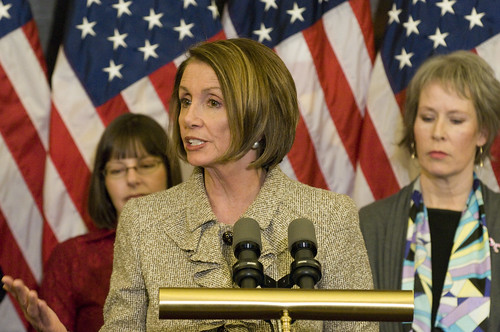
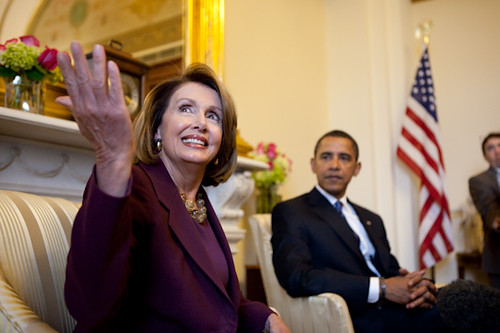
Speaker Pelosi and President Obama, take a bow
I didn't think I would blog tonight, despite many interesting developments in the political world since Sunday night (did you know that 24% of Republicans think our President could be the Antichrist?)  I strive for substance over filler on this blog, and I didn't feel I could summon the mental energy to write a quality post, but something caught my attention which was just too good not to share.  Following up on Sunday's posting about the health insurance reform bill, I was directed to this fantastic, clearly-defined blog posting from Speaker Pelosi's website detailing further what Americans can immediately expect from the health care bill; there's something for everyone:

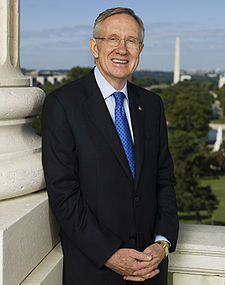
(And before you check the posting below, just another note that the health care bill has now jumped in popularity since even last weekend, "By 49%-40%, those polled say it was 'a good thing' rather than a bad one that Congress passed the bill."  Compare that to approximately 45% for/48% against on March 9th, not too shabby.  Now that Americans can stop hearing about the sausage-making that went on for 14 months and can start focusing on what the legislation will actually do for them, these reform measures will only rise in popularity.  Also, Sen. Harry Reid is aiming to have the Senate pass the reconciliation bill on Saturday, which will put the final fixes to the reform bill in place, so we will be officially free and clear of this debate.  Onwards to financial reform!)

Lastly lastly: this photo is just beyond words.


What’s In The Health Reform Bill For You Right Away?

March 23rd, 2010 by Karina
Under the legislative package the House passed on Sunday (the Senate-passed health bill as amended by the reconciliation bill) many key provisions take effect this year - here are some of them:

IF YOU ARE A SMALL BUSINESSES OWNER:
SMALL BUSINESS TAX CREDITS—Offers tax credits to small businesses to make employee coverage more affordable. Tax credits of up to 35 percent of premiums will be immediately available. Effective beginning for calendar year 2010. (Beginning in 2014, small business tax credits will cover 50 percent of premiums.)

IF YOU ARE A SENIOR:
BEGINS TO CLOSE THE MEDICARE PART D DONUT HOLE—Provides a $250 rebate to Medicare beneficiaries who hit the donut hole in 2010. Effective for calendar year 2010. (Beginning in 2011, institutes a 50% discount on brand-name drugs in the donut hole; also completely closes the donut hole by 2020.)

FREE PREVENTIVE CARE UNDER MEDICARE—Eliminates co-payments for preventive services and exempts preventive services from deductibles under the Medicare program. Effective beginning January 1, 2011.

HELP FOR EARLY RETIREES—Creates a temporary re-insurance program (until the Exchanges are available) to help offset the costs of expensive health claims for employers that provide health benefits for retirees age 55-64. Effective 90 days after enactment.

IF YOU HAVE PRIVATE HEALTH INSURANCE:
NO DISCRIMINATION AGAINST CHILDREN WITH PRE-EXISTING CONDITIONS—Prohibits health plans from denying coverage to children with pre-existing conditions. Effective 6 months after enactment. (Beginning in 2014, this prohibition would apply to adults as well.)

NO RESCISSIONS—Bans health plans from dropping people from coverage when they get sick. Effective 6 months after enactment.

NO LIFETIME LIMITS ON COVERAGE—Prohibits health plans from placing lifetime caps on coverage. Effective 6 months after enactment.

NO RESTRICTIVE ANNUAL LIMITS ON COVERAGE—Tightly restricts new plans’ use of annual limits to ensure access to needed care. These tight restrictions will be defined by HHS. Effective 6 months after enactment. (Beginning in 2014, the use of any annual limits would be prohibited for all plans.)

FREE PREVENTIVE CARE UNDER NEW PLANS—Requires new private plans to cover preventive services with no co-payments and with preventive services being exempt from deductibles. Effective 6 months after enactment.

NEW, INDEPENDENT APPEALS PROCESS FOR NEW PLANS—Ensures consumers in new plans have access to an effective internal and external appeals process to appeal decisions. Effective 6 months after enactment.

MORE FOR YOUR PREMIUM DOLLAR—Requires plans to put more of your premiums into your care, and less into profits, CEO pay, etc. This medical loss ratio requires plans in the individual and small group market to spend 80 percent of premiums on medical services, and plans in the large group market to spend 85 percent. Insurers that don’t meet these thresholds must provide rebates to policyholders. Effective on January 1, 2011.

NO DISCRIMINATION BASED ON SALARY—Prohibits new group health plans from establishing any eligibility rules for health care coverage that have the effect of discriminating in favor of higher wage employees. Effective 6 months after enactment.

IF YOU DON’T HAVE HEALTH INSURANCE:
IMMEDIATE HELP FOR THE UNINSURED WITH PRE-EXISTING CONDITIONS (INTERIM HIGH-RISK POOL)—Provides immediate access to insurance for Americans who are uninsured because of a pre-existing condition - through a temporary high-risk pool – until the Exchanges up and running in 2014. Effective 90 days after enactment. (Beginning in 2014, health plans are banned from discriminating against all people with pre-existing conditions, so high-risk pools would phase out).

EXTENDING COVERAGE FOR YOUNG PEOPLE UP TO 26TH BIRTHDAY THROUGH PARENTS’ INSURANCE – Requires health plans to allow young people up to their 26th birthday to remain on their parents’ insurance policy, at the parents’ choice. Effective 6 months after enactment.

GENERAL REFORMS:
COMMUNITY HEALTH CENTERS—Increases funding for Community Health Centers to allow for nearly doubling the number of patients served over the next 5 years. Effective beginning in fiscal year 2010.

MORE PRIMARY CARE DOCTORS—Provides new investment in training programs to increase the number of primary care doctors, nurses, and public health professionals. Effective beginning in fiscal year 2010.

HEALTH INSURANCE CONSUMER ASSISTANCE—Provides aid to states to establish offices of health insurance consumer assistance to help consumers file complaints and appeals. Effective beginning in FY 2010.

A NEW, VOLUNTARY, PUBLIC LONG-TERM CARE INSURANCE PROGRAM—Creates a long-term care insurance program to be financed by voluntary payroll deductions to provide benefits to adults who become functionally disabled. Effective on January 1, 2011.
And in 2014, once the exchanges have formed, more insurance reforms go into effect, including:
NO DISCRIMINATION AGAINST ADULTS WITH PRE-EXISTING CONDITIONS
BAN ON HIGHER PREMIUMS FOR WOMEN
PREMIUMS BASED ON AGE CAN ONLY VARY BY A MAXIMUM OF 3-TO-1 RATIO
CAP ON OUT-OF-POCKET EXPENSES for private health plans

Sunday, March 21, 2010

Why I Support The Health Insurance Reform Bill


Speaker of the House Nancy Pelosi

The interminable march towards health care reform (HCR) is continuing in earnest today, with an end finally (FINALLY) in sight.  So what is actually happening right now?  And what's this "reconciliation" business all about?  There's no good way to sum up parliamentary procedures into a bite-size format, so bear with me, as this email will be long.  


Procedural Issues

In brief, the House of Representatives voted today on the HCR bill passed by the Senate in December.  The Senate bill, as you may have heard, includes some rather unsavory deals that were cut in order to win 60 votes and to pass the bill; deals such as the "Cornhusker Kickback" that was negotiated by Sen. Ben Nelson (D-NB) that would provide indefinite federal funding to cover the expected increase in Nebraska's Medicaid costs due to expanding coverage to more people (Medicaid is paid for in part by federal funds and in part by state funds, so any increase in Medicaid costs will cost the states directly).  The Kickback and other deals that were made for specific Senators in specific states to win their votes are obviously not terribly popular with rank-and-file Democrats, and so by the House voting for the Senate bill as it is, they made those Senate deals into law.

However, over the last few weeks President Obama, Nancy Pelosi, Harry Reid, and other key Democrats in both chambers of Congress have worked out a deal to pass a reconciliation bill that "fixes" all of the deals that were passed in the Senate bill and that will work to further reduce the deficit (the Congressional Budget Office, the main non-partisan arbiter of all things budgetary, has stated that the bill will reduce the federal deficit by $140 billion over the first 10 years it is in place and by $1.2 trillion over the second 10 years it's in place, although those numbers are subject to a large amount of skepticism on both sides).  This reconciliation bill will be voted on tonight by the House once the Senate bill is passed by the House, and then that reconciliation bill is supposed to be passed by the Senate, hopefully later this week, although the timing is debatable.  Members of the House are afraid that the Senate will seek to alter the reconciliation bill, upsetting the delicate balance that has been struck between leadership and the members, although Senate leadership has worked to reassure nervous House Democrats that the Senate will pass the bill as-is.  Any changes that are made in the Senate will have to be voted upon again by the House before President Obama can sign the bill, delaying the legislation further, an outcome Democrats are working to avoid.  

So is the use of reconciliation by the Democratic majority "unconstitutional" or a "nuclear" procedure, as Republicans have sought to portray it?  Well, considering that the majority of the uses of reconciliation have come when Republicans were the majority in Congress (16 out of 22 reconciliation bills) it seems a bit rich for Republicans to call it an extraordinary procedure now.

Finally, abortion.  A lot of hay has been made in the last few weeks about whether there is any federal funding of abortion in this HCR bill, and the fact is, there never was any federal money for funding abortions.  There is a provision in the House called the Hyde Amendment, that bans spending federal money on abortions, and the HCR bills that have been debated have always upheld that provision.  It has now been reported that President Obama has issued an Executive Order banning the use of federal money on abortions, as an extra safeguard, so thankfully, this argument is now moot.


Why I Support The Bill

The primary reason that I am in favor of passing this bill, despite the fact that it does not include the most effective cost-saving measures of either a public option or single-payer system, is that the bill enshrines in US law the fundamental concept that health care is a right, not a privilege.  For too long in this country, we have consigned our fellow Americans to suffer from treatable, often preventable illnesses and conditions by claiming that people have the "choice" to buy health insurance if they want it.  Sadly, the reality has never been quite so simple.  Two of the more significant reforms in this bill are those ending the denial of health insurance for those people with pre-existing conditions, and making illegal the use of rescission (where the insurer cancels your health insurance just when you need it most due to a usually dubious claim of "fraud" on your insurance application).  These two revisions alone will help keep far fewer people from going bankrupt due to medical care (click for shocking statistics).  

Consider the fact that if you receive your health insurance through your employer, as the vast majority of Americans do, what will you do if you lose your job?  You will have COBRA coverage for a few months, but generally COBRA is quite expensive, and moreover, it's temporary.  How many of you who are lucky enough to have jobs still are unwilling to leave a job that is no longer satisfying because you are afraid of losing your health insurance?  Is that lack of mobility not an impediment to your freedom?  Does not the health insurance system we have now foreclose upon choices that we would otherwise have if we were assured of health insurance?  Far from reducing our freedom as many opponents of the bill have claimed, this bill will greatly enhance freedom and will enhance job mobility.

For small business owners and entrepreneurs who would like to start out on their own, but are not able to afford exorbitant health insurance costs, this bill provides subsidies for health insurance for their employees.  Whereas the current system has skewed the benefits towards existing companies, and especially towards companies with large employee bases that can be insured under group plans, this bill begins to level the playing field between newer and more-established businesses, and between larger and smaller businesses.  

As a young person, I will be paying for this bill for the rest of my days, and despite that (in fact, because of that) I still support it.  I have faith that the bill will be improved, refined, expanded, and remade in time.  Young people are the linchpins upon which reform depends.  The reason we have coverage mandates in the bill is so that younger, healthier people (who tend not to buy health insurance) will be forced to buy insurance.  Younger people tend to have better health than the not-as-young, and because of that, it is unlikely that a young person will spend as much on health care as they pay in annual premiums.  The idea is that the insurance companies will shift those excess premium dollars (after shaving off a nice profit) to pay for more expensive people's health care, who may have spent more on care than they paid in premiums.  So they need us, which is a reason why the HCR bill has a provision that allows dependent children to be covered under their parents' health insurance plan until they're age 26.  As long as somebody's paying the premiums for their insurance and not costing insurance that much money on care, the insurance companies are happy.

Finally, I support this bill because even if you have insurance and you're happy with it, you already are paying for the uninsured.  In fact, you're paying quite a lot for the uninsured, and it'll only get worse unless something is done.  When a person does not have health insurance and gets sick, they'll probably wait until they're really sick and then go to the emergency room for treatment.  As everyone is surely well aware, emergency room treatment is the most expensive kind, and when patients can't pay the hospitals back for the care they've received, the hospitals then charge insurers more for patients with insurance, which leads to higher premiums for insurance, which more people can't pay, and so they become uninsured...the cycle goes on.  This bill is an attempt to stop that cycle.

It's not perfect by any stretch of the imagination, but this bill is far, far better than the status quo.  For more information, see the two links below, both by the non-partisan Kaiser Family Foundation's Health News:

Friday, February 19, 2010

The Upside of Scott Brown's Election...

Breakdown of political party representation in...Image via Wikipedia
...the Democrats in the Senate have finally been freed of having to seek the ever-elusive "60th vote" to pass health care reform.  I had discussed the reconciliation process a few months ago, but it finally seems that Harry Reid is prepared to use a majority vote to pass health care reform, regardless of what the "moderate" Democrats say.  By losing the 60th seat in the Senate, Democrats have been forced to seek other methods to pass legislation than negotiating with their own corporate-owned members (see Ben Nelson, Mary Landrieu, Joe Lieberman, etc.) and this has led directly to using the reconciliation rule.  So this week a major push has been made by a range of Senate Democrats to include a public option in the reconciliation bill, with Senators from Dianne Feinstein (pretty moderate) to Chuck Schumer (former head of the Democratic Senatorial Campaign Committee during the 2006 and 2008 elections, who is widely regarded for his political acumen) signing on to the letter to Majority Leader Reid.  But hold on a minute, isn't the public option a HUGE LOSER among the public?  Don't Americans want less government intervention?  Well, not really, it turns out.  A poll of Nevada voters released yesterday contains some stunning revelations - 56% of Nevada voters favor "the national government offering everyone the choice of buying into a government administered health insurance plan" versus 38% opposed.  Nevada, if you'll remember, was a major battleground state in the 2008 election; after being solidly Republican for many years (with a strong Libertarian, anti-government streak to boot) President Obama prevailed there in the general election, so Nevada's a pretty good bellwether state through which to gauge the national mood.  The poll also has implications for Harry Reid's reelection prospects, as he is not doing too well in polling in his home state, so a strong move to pass Democratic legislation could in fact help his prospects in Nevada.


We will see what happens, and I'll try to be a bit better about posting timely information, as health care reform continues to provide lots of twists and turns to keep track of.

Monday, December 21, 2009

Another reason to pass the healthcare bill...

Official photo of United States Senator and Mi...Senate Minority Leader Mitch McConnell.  Image via Wikipedia
Is so that the Republicans in the Senate won't block funding for the troops anymore???  Yes, this is truly crazy, but the GOP attempted last Thursday to delay the healthcare bill through filibustering the defense appropriations bill; by holding up the defense bill, that could throw off the carefully crafted schedule Harry Reid put together to pass healthcare before the Christmas recess.  The Senate's parliamentary maneuvers and roadblocks have been on full display during the healthcare debate of late, however, Congressional historians agree that filibustering one non-controversial bill to block a controversial one is rather unprecedented.  Mitch McConnell, Senate Minority Leader, proving once again that principles can always take a backseat to political expediency.

Tuesday, November 24, 2009

Reconciliation and Health Care Reform in the US Senate


The health care reform debate has taken up a lot of the country's attention over the last six months or so, and while it feels like every little step has been "momentous" (the votes of the individual committees such as Finance and the HELP committee in the Senate, the passing of the House health care reform bill a couple weekends ago) it is now, truly, game time.

The House of Representatives passed a bill that includes a bevy of essential health insurance reforms including requiring all who do not already have health insurance through either Medicare, Medicaid, employer-based health insurance, or individual private plans to purchase insurance. This is called an individual mandate, and it is a key element of reform, in that it is a central tenet of economics that in order to get people to do anything in large numbers, you must either offer negative incentives (the stick) or positive incentives (the carrot). So if all of those who are uninsured are going to be required to buy health insurance, how can we ensure that health insurance is affordable? Here is where the political/ideological sticking point that has held up reform for so long is located. One initial plan pushed by the progressive Democrats in Congress was for a single-payer plan, which is defined by Physicians for a National Health Program as "a system in which a single public or quasi-public agency organizes health financing, but delivery of care remains largely private." This maximizes the government's leverage in negotiating reimbursement rates with insurers so that efficiency is given priority and administrative costs are kept low (with executive compensation hopefully kept low too). Needless to say, the single-payer option was given a quick shove out the door by the Democratic leadership and those who receive large amounts of campaign contributions from the health care and health insurance industry.

So the compromise option for Democrats became what is called the "public option," perhaps you've heard of it? While there are many variations on what the public option would be, the main elements of the public option is to create a government-administered competitor to the health insurers, many of whom operate with virtual monopolies in many states. The public option would create a government-run insurance exchange where those who are currently uninsured (i.e. those who earn too much to qualify for Medicaid, those who are unable to purchase insurance currently due to "pre-existing conditions," or young people who are healthy) could purchase their newly-mandated insurance coverage. the most robust version (i.e. most cost-cutting version) would have what's called "Medicare plus 5," where reimbursement rates to health care providers would be set at Medicare rates plus 5% on top of that. The advantage of the public option compared to our current system is that it pools people together to have stronger leverage in negotiating rates with providers, as well as having lower administrative and executive compensation costs (compensation costs are significant, truly.) Without the Medicare plus-5 option, the public plan would be forced to negotiate its reimbursement rates separately from the much-larger Medicare pool, and therefore would not be able to save as much money, resulting in higher premiums for those under the program and more government subsidies to help people buy insurance, thus costing the taxpayers more money.

Sadly, yet predictably, the weaker public option passed the House, due to the entirely inconsistent arguments of "fiscally conservative" Democrats that the most robust public option would cost taxpayers too much money. To add insult to injury, a last-minute legislative offensive by anti-abortion Democrats inserted an abhorrent amendment adding major restrictions on abortion provisions to the health care bill, but that's a whole other topic. Suffice it to say that the amendment authored by Rep. Bart Stupak (D-MI) will hurt poor women the most, as if they don't have enough on their plates already.

So now it comes to the Senate, led by Harry Reid of Nevada, to debate health care reform. While the majority of Senate Democrats support the public option, there is a bloc of 4 who are holding things up by hemming an hawing about filibustering the health care bill if a public option is included. The filibuster (for those who haven't taken civics classes in a while) is a parliamentary tactic used by Senators to hold up votes on a bill, and indeed, all work in the Senate, indefinitely. The filibuster is a major obstacle to getting bills passed generally, and the way to end debate in the Senate is by 60 senators voting to invoke cloture of the debate. Despite the Democrats having 60 votes in the Senate (in truth it's 58 plus Joe Lieberman of Connecticut and Bernie Sanders of Vermont who normally caucus with the Democrats) the 4 holdouts mentioned before may not vote to pass healthcare unless the bill is heavily watered-down and/or the public option stripped out entirely. To prevent the from filibuster from killing the bill, Sen. Reid can use another parliamentary tactic to combat the filibuster called reconciliation, which is essentially to vote only on the parts of the bill that directly involve the federal budget. Reconciliation limits debate (i.e. filibustering is not allowed) and requires only 51 votes to pass, versus the 60 to end a filibuster. Using reconciliation would allow a much stronger bill to pass the Senate, as Sen. Reid can round up a group of strong Democrats to pass a robust public option without having to kowtow to the wishes of those senators who are bought and paid for by the insurance industry. The downside to reconciliation is that those parts of the bill that do not directly affect the budget could not be included in the health care bill and would need to be voted on separately, and that it would create an open war with the Republicans, who would accuse the Democrats and President Obama of violating their pledge of seeking greater bipartisanship.

That being said, we're at a major point of decision here; we've never been this close to comprehensive health care reform for all, and for the good of the country and our nation's future, if it takes reconciliation to pass the best bill possible, then I'm all for it. The Republicans have offered no serious reform bill of their own and have made it clear that they will stand united against anything that alters the status quo and/or is one of President Obama's legislative priorities. If the Democrats don't pass this bill, they're going to take massive losses in the 2010 elections, as former Gov. Howard Dean of Vermont predicted recently, and they will absolutely deserve those losses, as there is major support for health care reform in this country right now, with recent polls showing 72% of Americans supporting the public option. If we can't do it now, then when? Why must our health and well-being be subject to the profits of insurance companies? What is the price of inaction? With over 45 million uninsured in this country, it is huge.

Firedoglake, a premier progressive blog, has a petition set up urging Sen. Reid to pursue reconciliation to achieve the strongest bill possible for the good of us all. While my posting here elides over many of the nuances and difficulties inherent in trying to achieve major reform, and there's no guarantee that everything will get better once health care reform is passed, it's better to try and fail than wake up in the future and wonder what could have been. Please sign the petition, for the good of our country's fiscal future and future generations.