Showing posts with label reform. Show all posts

Saturday, October 27, 2012

An Election of Superlatives

Consider the unprecedented nature of the decision we have to make on November 6th between the two major-party candidates.

On the one hand, we have an incumbent President who is also a Nobel Peace Prize winner.  This man, lauded for his efforts to bring “peace” to the world by the perhaps-naive Nobel Committee, is also presiding over the expansion of apparently perpetual secret/shadow wars to kill “terrorists/enemy combatants” on what appears to be a virtually unlimited battlefield through the use of unmanned drone strikes.

Among senior Obama administration officials, there is a broad consensus that such operations are likely to be extended at least another decade. Given the way al-Qaeda continues to metastasize, some officials said no clear end is in sight.

“We can’t possibly kill everyone who wants to harm us,” a senior administration official said. “It’s a necessary part of what we do. . . .We’re not going to wind up in 10 years in a world of everybody holding hands and saying, ‘We love America.’ ”

On the other hand, we have a fabulously wealthy financier whose belief in “American exceptionalism” is so great that he made (and continues to make) quite a bit of his money through offshoring American jobs to foreign nations, including China, a country that he has vowed to “get tough on.”

Right now a company named Sensata is moving equipment out of a factory in Freeport, Ill., and shipping it to a factory in China. Sensata will be laying off all of the American workers, but first they are making the workers train their Chinese replacements. The workers' last day is the day before our election. Here's the thing: This company is owned by Bain Capital, and Mitt Romney -- who says he is against shipping jobs to China -- will make a fortune from the move to China.

The Sensata employees have set up a camp outside the factory that they call Bainport and are trying to stop the Bain trucks that are moving the equipment out for shipment to China. These soon-to-be-jobless workers have asked Romney to come help them.

This is a tremendous opportunity for Mitt Romney. As the former head of Bain Capital and with all the visibility of a presidential campaign, he could step in and help these workers. It offers him the chance to demonstrate to voters that he means the things he says on the campaign trail, and is not just saying these things to get votes. But Romney has refused.

And one more bite at this bitter offshoring apple:

"Romney's campaign did not deny that he profited from the auto bailout in an email to The Hill, but it said the report showed the Detroit intervention was 'misguided.'"

The truth? On June 1, 2009, the Obama administration announced that Detroit Piston's owner Tom Gores, GM and the US Treasury would buy back Delphi.The plan called for saving 15 of 29 Delphi factories in the US.

Then the vulture funds pounced.

The Nation discovered that, in the two weeks immediately following the announcement of the Delphi jobs-saving plan, Paul Singer, Romney's partner, secretly bought up over a billion dollars of old Delphi bonds for pennies on the dollar.

Singer and partners now controlled the company - and killed the return of Delphi to GM.

These facts were revealed in a sworn deposition of Delphi's Chief Financial Officer John Sheehan, confidential, but now released on the Web.

Sheehan said, under oath, that these speculators threatened to withhold key parts (steering columns), from GM. This would have brought the auto maker to its knees, immediately forcing GM's permanent closure.

The extortion worked. The government money that was supposed to go to save jobs went to Singer's hedge fund, Elliott Management Corporation and its partners, including the Romneys.

Once Singer's crew took control of Delphi, they rapidly completed the move to China, sticking the US taxpayers with the bill for the pensions of the Delphi workers cut loose.

Dan Loeb, a million-dollar donor to the GOP, who made three-quarters of a billion dollars off the legal scam, proudly announced that, once he and Elliott took control, Delphi kept "virtually no North American unionized labor."

In all, three hedge funds run by Romney's million-dollar donors have pocketed $4.2 billion, a return on their "investment" of over 3,000 percent - all care of the US taxpayer. The Romneys personally earned a minimum of $15.3 million, though more likely $115 million - a range their campaign does not dispute.

So there you have it.  Perpetual war from a Nobel Peace Prize winner, and a history of profiting off of job offshoring from the man who claims his business acumen makes him uniquely qualified to lift the American economy out of its doldrums and create jobs.  These are the two candidates who will receive the vast majority of votes in less than 2 weeks’ time.

There are other candidates out there, of course.  There is Gary Johnson, the standard-bearer for the Libertarian Party, and there is Jill Stein, the candidate for the Green Party.  And beyond those two (the most prominent of the third parties, due to their being on the ballot in most states) there are countless other candidates to choose from.

It is notable that the two major party candidates would both bring with them more war, and the two primary third-party candidates would both not only end the wars the U.S. is currently engaged in, but cut the military budget and global footprint further than even proposed under the dreaded “sequester”.  Why do we never hear from the third party candidates in the mainstream media (even when one of them gets arrested outside the second presidential debate for “disorderly conduct” for trying to enter the building and participate)?  Could it be that war is always good for business, particularly for the media?  Are Americans not “ready” to hear what these other parties have to say, or is the game rigged to only operate in black-and-white mode, and thus deny a real choice?

I’m certainly not the first person to notice the conundrum that what we view as American “democracy” is truly a carefully-curated pageant that restricts the amount of political choice Americans are presented with.  According to the Commission on Presidential Debates (the CPD, itself a product of a bipartisan agreement between the two major parties) a candidate must receive 15% of support in national polling to be allowed to participate in the prime-time televised presidential debates:

The CPD's third criterion requires that the candidate have a level of support of at least 15% (fifteen percent) of the national electorate as determined by five selected national public opinion polling organizations, using the average of those organizations' most recent publicly-reported results at the time of the determination.

And how, one might ask, does a candidate receive 15% of public support outside of being involved with the two major party apparatuses?  MONEY!  It certainly worked for billionaire (and anti-NAFTA economic nationalist, I might add) Ross Perot, didn’t it?  He ended up with 18.9% of the vote in the 1992 election, to Bill Clinton’s 43% and George H.W. Bush’s 37.5% after appearing onstage with the two major party nominees – having a well-funded 50-state operation can make outcomes like that happen.

“But we have a public financing system for the presidential race!” you might say.  And you would be right, we do.  But again, you get to the chicken-and-egg difficulty of trying to make an impact on the national electorate without the aid of money, which can help one buy media coverage (or without media coverage, which can help one to raise more money):

Minor or third party nominees may also be eligible for federal funding, but the process is a bit more complex.  A minor party candidate's public funding grant is based on a formula subject to the percentage of votes the party received in the previous presidential general election. The candidate is only eligible for general election public funds if the party's candidate received at least 5 percent of the vote in the previous presidential election.

How does one get one’s name and message out to the public without media coverage, so as to achieve polling and electoral support needed to gain access to both the debates (which again, serve to further get one’s name and message out to the public) and to public financing?  How does one raise money without media support, in order to show electoral viability?  How does one get media coverage without money to run ads, which, again, portray a sense of viability? 

Five percent of the national vote may not sound like a high bar to hurdle, but consider that in the 2008 election, approximately 127 million votes were cast.  Thus, you’d need about 6,350,000 votes to make the 5% threshold that would enable your party to access public financing. 

A useful Wikipedia page detailing the 2008 Presidential election fundraising totals shows the overall fundraising and spending breakdowns for the candidates (I’ve only left in the two major party candidates and the Libertarian and Green Party candidates for brevity:


Candidate (Party) Amount raised Amount spent Votes Avg $ per vote
Barack Obama (D) $778,642,962 $760,370,195 69,498,215 $10.94
John McCain (R) $383,913,834 $358,008,447 59,948,240 $5.97
Bob Barr (L) $1,383,681 $1,345,202 523,713 $2.57
Cynthia McKinney (G) $240,130 $238,968 161,680 $1.48

*Excludes spending by independent expenditure concerns.

Source: Federal Election Commission


To say that the third parties were outgunned in 2008 is a massive understatement.  The Libertarian candidate received about 8% of the 6,500,000 votes he would have needed to cross that 5% threshold to achieve public financing for the next election cycle, and the Green party candidate received about 2.5% of the number of votes needed to achieve 5% of the national vote.  Clearly there is a lot of ground to be made up!

If you view the realm of politics as a market, you will notice that the choices presented by our media and the official apparatus that governs presidential debates comprise a duopoly – there are only two choices, we are told. 

And yet, are there no worthwhile policy ideas beyond the Democratic and Republican 2012 party platforms?  If you care about enhancing the peacefulness of our world, it does not appear that you have a great option among the two major parties this year.  If you care about holding Wall Street accountable for the massive frauds perpetrated on the American public, and want to see the perpetrators go to jail, well you’re not going to find your candidate in the major parties this cycle either. 

Let me be clear: I am in no way, shape, or form arguing that there are not differences between the Democratic and Republican candidates for president this year; such arguments are a frequent meme among political cynics, but they are without merit.  The differences are stark, in terms of foreign policy, fiscal policy, social policy, etc.  Those differences ought not to be glossed over.  I am also not arguing the relative value of one or the other side’s polices at this point, despite my fairly obvious leanings.  Those arguments are for another time.

My point is simply that there are other ideas out there, other voices, and other constituencies that our political system, our democracy, is at present set up to exclude, rather than include.  This amounts to an undermining of free speech, of the free flow of ideas that theoretically characterizes the superiority of a representative democracy over other forms of government.  Let the two major parties have their ideas and policies challenged in an open debate; let the American public be offered something more than a two-party choice. 

Such changes clearly will not happen this election cycle, but through organizing and building constituencies, positive changes can be made for the future to break the two-party hold over political discourse in this country.  I have some ideas on this topic to expand upon at a later date, given the time.

Monday, November 21, 2011

The #Occupy movement and the generations

Just a short note of gratitude and no small amount of incredulity at the cross-generational dialogues that have been fostered through and around the Occupy movement, which I and others view as largely a Millenial generation-driven thing.  I was just reading a well-done post by Charles B. Pierce at Esquire’s Politics Blog and noting his tone lamenting the political fecklessness of many of those from his generation now holding the reins of power:

How hard can this be? How hard is it to tell people to get angry at the people who really are making off with their country's wealth and their personal futures, especially when it's the god's honest truth? How hard is it to tell people that they are not the enemy, that to shoot pepper spray into the eyes of a college student is to spit in the eye of everyone else? Please do not hand me concerns for your "political viability." That makes you cowards. The protesters are doing the hard work. They're the ones living in a dozen tiny Argentinas all around this country. They're the ones getting beaten up and tortured, on TV, with chemical agents. They're the ones going to jail. All I'm asking is that you all have their backs, and all you have to do is get up and give a whole bunch of speeches saying so. Right now, they're pretty much out their on an island while empty charlatans like Newt Gingrich and prissy little shmoes like David Brooks are beating them over the head rhetorically, while the cops are more than happy — indeed, damned near gleeful — to do it in person.

Barney Frank wonders where the Occupiers were during the elections of 2010? Give them a politics worthy of their courage and they'll show up. This does not seem to me to be a difficult problem, but it does appear possibly to be the last chance for progressive politics for an awfully long time. You don't need an $850,000 contract to see that.

That second bolded sentence “Give them a politics worthy of their courage and they’ll show up” sounds like one of the best lines I’ve heard this year, for both its succinct razor-edge of truth, to its political astuteness.  This generation out protesting, my generation, is the one that greatly helped President Obama get elected.  We came out of the Bush era scarred (as I’ve noted previously) and looking for a change that Obama appeared to represent.  But more than that, he represented prudent judgment in correctly sizing up many of the true threats to our country (the undercutting of civil liberties domestically and human rights abroad, being cogent for me in particular) and, yes, a courage in his opposition to the Iraq War that was greatly lacking in the politics of those days, and even moreso today.  The reality of President Obama has been drastically different from the representation of Candidate Obama, but at the time, he showed a side of politics that people yearned for.  Show us courageous politicians taking stands that put them on the right side of popular sentiment, particularly in the face of a potential loss of big money campaign donors, and I bet my generation will show up.

So it is with that background in mind that I have been considering the amount of support I see and hear from older generations for the movement now sweeping America.  A close family member informed me that on her recent trip to New York she happened upon an Occupy Wall Street group at a public park (not Zuccotti, mind you) and was very impressed with the “human microphone” and the positive, steadfast energy the group displayed, despite it being an awful, rainy NYC November day.  The Facebook posts I see from Gen-Xers, Baby Boomers, and on up regarding the Occupy Movement evince a strong bond between the generations that I don’t think I’ve ever seen as clearly in my life. 

I had always feared that the elites’ plan to divide the entitlement program pie, and to set those of us in younger generations on a different retirement plan than our parents, threatened to separate the generations (which is probably the point!) and why you still hear many GOP candidates discussing giving young people the “option” of purchasing health savings accounts and the like.  The fact that we’re all working and saving towards a common fund, a common vision, means we’re all in it together, to some extent, despite the fact that the powers-that-be want all that locked-up Social Security and Medicare money to be released to the predations and speculations of Wall Street. 

But now, the elites have played their hand too far.  They’ve effectively united a strong bloc of people across the generations because, let’s face it, we’ve all been looted in some way or another.  We recognize a common enemy: the collusion between big business and big government that works to undercut our rights and to separate an already economically-stratified society into one where you have vastly different justice systems, depending on your standing and net worth (witness this egregious hit-and-run case from Colorado last year involving a “wealth manager” and a cyclist for a great/horrifying example).  There’s no justice for those on the top, but a harsh and exacting justice for those of us not at the top.  Witness the UC Davis pepper-spraying last Friday:

Glenn Greenwald’s take on the UC Davis situation adroitly points towards the larger issue at play in our society:

The UC-Davis Chancellor responsible for the pepper-spraying of her students, Linda Katehi, today went on Good Morning America and explained why she should not resign or otherwise be held accountable: “we really need to start the healing process and move forward.” On a radio program in the afternoon, she expanded on this view by saying: “We need to move on.” So apparently — yet again — the only way everyone can begin to “heal” and “move forward” is if everyone agrees that those in power with the greatest responsibility be fully shielded from any consequences and that their bad acts be simply forgotten. I wonder where she learned that justifying rationale?

We yearn for justice as a society.  The concept of justice embedded in the Constitution argues that those at the top and those at the bottom ought to be equal in the eyes of the law, and yet, the past decade has clearly shown how far our society has gotten from those founding principles.  Occupy, for all of its media-unfriendliness and potential to turn off the “median voter,” is a nascent attempt at reclaiming that original concept of justice.  Justice is anathema to the powers-that-be, as their gains are largely ill-gotten and their positions in society often depend on their being the the best operators within a system of legalized corruption.  The moment their hold on power slips, and they no longer control the levers of power and the judiciary, they will be subject to the comeuppance that has been long in coming, and much delayed. 

Greenwald quotes Rosa Luxemburg’s epic comment to wonderful effect:

“Those who do not move, do not notice their chains.”

If you look askance at the Occupy movement, and you see nothing but a bunch of rowdy young people lacking drive and ambition, ask yourself how you’re constrained in your own life.  What cutbacks have you had to make to your hopes and dreams, let alone your financial position?  How many of those setbacks are due entirely to your own poor judgment or over-extension, rather than being at least in part the shock wave from a system of willfully-created asset bubbles and legislatively-endorsed corruption imploding upon itself?  If you trace the origins of your own problems back to their logical starting points, do they solely originate from your decisions?  That is the line of thinking the powers-that-be hope you’ll take away.  Heaven forbid you should look up the food chain to discover how usury has been made legal and how student loans are no longer discharged in bankruptcy; how insolvent banks are allowed to claim the full face value of toxic assets to bolster their bottom lines, and yet how lying to get food stamps to feed one’s two children can net you 3 years in federal prison.  “Justice,” these days, comes at the expense of the rest of us.  We can see this fact in all its harsh reality and find a unity in it, or we can deny deny deny that the mirror the Occupy movement is holding up to our society reflects far more of our collective life experiences of brokenness and unnecessary misery than we’d care to admit. 

Thank you to those of the older generations who see the Occupy movement not as a threat, but as the opportunity for a rebirth.  We need you, and you need us.  We ARE in this together.

Monday, May 10, 2010

The future of finance?

My schedule has not permitted me to post anything fully-developed for quite a while, but tonight I have a few multimedia treats for you, building off of the news themes of recent weeks.

First off, "Quants, The Alchemists of Wall Street."  A film made about the mathematical geniuses who created the models that have been largely running the financial world for a number of years now.  While that may not sound like the most interesting subject matter, I highly recommend taking 45 minutes and watching the film, there's lots to learn:


I thought this was an interesting little film as it stood, however the second half takes a surprisingly prescient turn in that the interviewees (or "quants," short for "quantitative thinkers," I assume) begin to discuss "high frequency trading," a term that sprang into the wider international consciousness following last Thursday's as-yet-unexplained 1,000 point drop in the Dow.  The idea of high frequency trading (or HFT) is that arrays of computers are set up to catch any variations in a stock's price that exceed or fall below certain parameters, or that follow Google search terms and will buy or sell stocks based on what's "hot" on Google at that moment.  Those parameters are set by mathematical models created by quants.

There are a host of scary implications that result from high frequency trading (not least of which is that these computers essentially set up parallel market structures that operate outside of public scrutiny) however there is a somewhat more mundane detail that the film raised that I'd like to focus on.

One of the quants notes that the NYSE is going to be (or perhaps already has by this point) setting up a warehouse in New Jersey that will house huge arrays of computers, each belonging to the various financial firms, where they will engage in further HFT.  The idea is that the computers will be closer to the NYSE than before, and therefore they will have a faster data connection to the stock market.  A further implication is that certain firms will get "privileged" connections that will afford them a tenth of a second advantage over the other firms; how those firms are chosen, be it through lottery or through financial transactions with the NYSE (read: bribes), is unclear.

There are certain industries in the world that are capital-intensive, in the sense that those industries required a large amount of resources, be it money, physical inputs, or large areas of land, to operate.  Steel is a capital-intensive industry, as is telecommunications, which requires the development of a significant amount of infrastructure to operate.  Clearly the world of finance is a capital-intensive industry, as a firm generally requires large amounts of money to operate, however "boutique firms" have always existed that were able to operate with smaller amounts of cash.  With this impending shift to a computer- and geographically-dominated business model, I wonder if finance is becoming more capital-intensive too?

Consider that if you're a small player, you're going to be forever outmaneuvered by the big firms who have prime locations for the fastest connections for their computer servers in New Jersey, plus offices full of top-quality quants figuring out the most accurate (or at least, the least wrong) algorithms that are then fed into the computer systems constantly.  How is a small firm supposed to compete against that?  This sort of situation can only lead to further consolidation of the financial sector into fewer firms controlling more of the wealth in this country.  As I discussed in my previous post, further consolidation of wealth is a very bad thing indeed.
__________________________________________________________________________________

And now for something only slightly different...

A further interesting implication of the film was the concept put forth by a couple of the quants that economists in recent years have begun to regard themselves as "scientists;" that their models predicting financial market movements and concepts were "laws" that would be proven correct no matter the circumstances.  This, despite the fact that economics has, since its inception, been considered to be one of the social sciences, these economists who were running the world of finance believed themselves to be masters of the financial universe.

There is a small problem with the underpinnings of these economists' views of the world, however: humans are messy.  To the extent that any sort of "science" is based on looking at human behavior in the aggregate there will always be room for inputs that simply break one's perfectly-calibrated model of the world.  So to the extent that finance is based off of the actions of many individual stock traders and firms run by financiers, perhaps it, too, should be considered a social science?  At least the world of theoretical finance, such as the world in which these quants operated should be, as they're modeling human actions in the aggregate, much in the same way that economists do.  Therefore, as even the quants recognize in the film, their models may not have failed, but the ways that the models were used and manipulated by the non-quant stock traders to make money is at least one part of what contributed to the financial meltdown in 2008.  Humans are unpredictable, and while it's a valiant effort to try to model human behavior, the more I read and the more I learn, the more futile, ultimately, I think it may be.  Just a small observation...

__________________________________________________________________________________

Finally tonight, the terrible, terrible story of what happens when the financial markets run out of subprime mortgages to invest in: they turn to "commodities."  Commodities markets trade derivatives of actual, physical goods, such as corn/maize futures, oil futures, or gold.  I don't wish to get into how the derivatives contracts work (partly because this post is already long enough and partly due to the fact that they're bloody complicated) but suffice it to say that firms betting on the futures markets can drive the prices of commodities up in a way that is completely unrelated to the underlying supply and demand fundamentals of that commodity.  Witness the continued high price of oil despite the fact that oil consumption is the lowest its been in years (see the link above for more on that).

These effects can be devastating for the poor and middle classes around the world, and sadly, the financial reform bills currently being debated in the Senate may do little to nothing to halt the devastation.

For Rounds 2 and 3 of the feature films tonight, I bring you an interview with Indian economist Jayati Ghosh, who explains to us that when finance gets its hands on the very food you seek to feed your family with, prices often will go up, to everyone's detriment.  This interview will infuriate you, and you'll want to yell at your computer screen "how can humans be so immoral as to create food bubbles and starve the poor???"  Well having seen "Quants" now, and gaining a bit of access into the mind of the modern financial mathematician, I can see, to an extent, how that might happen.  When you're dealing only in abstract numbers, looking for the most promising market to invest in, with no concept of the fact that your actions will increase the price of corn to be used for tortillas in the slums of Mexico, then it's very easy to buy into that bubble.  Does modern finance add any social value to our society?  It's really hard to tell these days, but I guarantee I'll come back to that theme.

Part 1:


Part 2:


I have been working on more complex postings having to do with the nature of the financial/political nexus that has developed and subsumed our political life in this country, and I hope to post those soon.  Furthermore, the oil spill in the Gulf of Mexico and the Greek debt crisis are all fodder for future postings, if there's time...

Tuesday, March 23, 2010

A Public Service Announcement

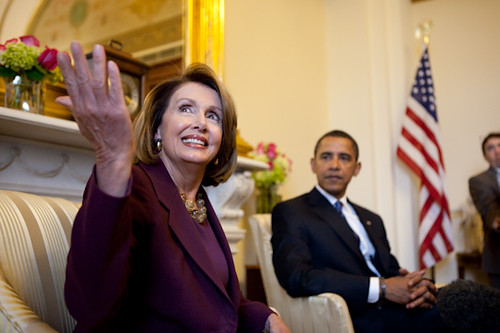
Speaker Pelosi and President Obama, take a bow
I didn't think I would blog tonight, despite many interesting developments in the political world since Sunday night (did you know that 24% of Republicans think our President could be the Antichrist?)  I strive for substance over filler on this blog, and I didn't feel I could summon the mental energy to write a quality post, but something caught my attention which was just too good not to share.  Following up on Sunday's posting about the health insurance reform bill, I was directed to this fantastic, clearly-defined blog posting from Speaker Pelosi's website detailing further what Americans can immediately expect from the health care bill; there's something for everyone:

(And before you check the posting below, just another note that the health care bill has now jumped in popularity since even last weekend, "By 49%-40%, those polled say it was 'a good thing' rather than a bad one that Congress passed the bill."  Compare that to approximately 45% for/48% against on March 9th, not too shabby.  Now that Americans can stop hearing about the sausage-making that went on for 14 months and can start focusing on what the legislation will actually do for them, these reform measures will only rise in popularity.  Also, Sen. Harry Reid is aiming to have the Senate pass the reconciliation bill on Saturday, which will put the final fixes to the reform bill in place, so we will be officially free and clear of this debate.  Onwards to financial reform!)

Lastly lastly: this photo is just beyond words.


What’s In The Health Reform Bill For You Right Away?

March 23rd, 2010 by Karina
Under the legislative package the House passed on Sunday (the Senate-passed health bill as amended by the reconciliation bill) many key provisions take effect this year - here are some of them:

IF YOU ARE A SMALL BUSINESSES OWNER:
SMALL BUSINESS TAX CREDITS—Offers tax credits to small businesses to make employee coverage more affordable. Tax credits of up to 35 percent of premiums will be immediately available. Effective beginning for calendar year 2010. (Beginning in 2014, small business tax credits will cover 50 percent of premiums.)

IF YOU ARE A SENIOR:
BEGINS TO CLOSE THE MEDICARE PART D DONUT HOLE—Provides a $250 rebate to Medicare beneficiaries who hit the donut hole in 2010. Effective for calendar year 2010. (Beginning in 2011, institutes a 50% discount on brand-name drugs in the donut hole; also completely closes the donut hole by 2020.)

FREE PREVENTIVE CARE UNDER MEDICARE—Eliminates co-payments for preventive services and exempts preventive services from deductibles under the Medicare program. Effective beginning January 1, 2011.

HELP FOR EARLY RETIREES—Creates a temporary re-insurance program (until the Exchanges are available) to help offset the costs of expensive health claims for employers that provide health benefits for retirees age 55-64. Effective 90 days after enactment.

IF YOU HAVE PRIVATE HEALTH INSURANCE:
NO DISCRIMINATION AGAINST CHILDREN WITH PRE-EXISTING CONDITIONS—Prohibits health plans from denying coverage to children with pre-existing conditions. Effective 6 months after enactment. (Beginning in 2014, this prohibition would apply to adults as well.)

NO RESCISSIONS—Bans health plans from dropping people from coverage when they get sick. Effective 6 months after enactment.

NO LIFETIME LIMITS ON COVERAGE—Prohibits health plans from placing lifetime caps on coverage. Effective 6 months after enactment.

NO RESTRICTIVE ANNUAL LIMITS ON COVERAGE—Tightly restricts new plans’ use of annual limits to ensure access to needed care. These tight restrictions will be defined by HHS. Effective 6 months after enactment. (Beginning in 2014, the use of any annual limits would be prohibited for all plans.)

FREE PREVENTIVE CARE UNDER NEW PLANS—Requires new private plans to cover preventive services with no co-payments and with preventive services being exempt from deductibles. Effective 6 months after enactment.

NEW, INDEPENDENT APPEALS PROCESS FOR NEW PLANS—Ensures consumers in new plans have access to an effective internal and external appeals process to appeal decisions. Effective 6 months after enactment.

MORE FOR YOUR PREMIUM DOLLAR—Requires plans to put more of your premiums into your care, and less into profits, CEO pay, etc. This medical loss ratio requires plans in the individual and small group market to spend 80 percent of premiums on medical services, and plans in the large group market to spend 85 percent. Insurers that don’t meet these thresholds must provide rebates to policyholders. Effective on January 1, 2011.

NO DISCRIMINATION BASED ON SALARY—Prohibits new group health plans from establishing any eligibility rules for health care coverage that have the effect of discriminating in favor of higher wage employees. Effective 6 months after enactment.

IF YOU DON’T HAVE HEALTH INSURANCE:
IMMEDIATE HELP FOR THE UNINSURED WITH PRE-EXISTING CONDITIONS (INTERIM HIGH-RISK POOL)—Provides immediate access to insurance for Americans who are uninsured because of a pre-existing condition - through a temporary high-risk pool – until the Exchanges up and running in 2014. Effective 90 days after enactment. (Beginning in 2014, health plans are banned from discriminating against all people with pre-existing conditions, so high-risk pools would phase out).

EXTENDING COVERAGE FOR YOUNG PEOPLE UP TO 26TH BIRTHDAY THROUGH PARENTS’ INSURANCE – Requires health plans to allow young people up to their 26th birthday to remain on their parents’ insurance policy, at the parents’ choice. Effective 6 months after enactment.

GENERAL REFORMS:
COMMUNITY HEALTH CENTERS—Increases funding for Community Health Centers to allow for nearly doubling the number of patients served over the next 5 years. Effective beginning in fiscal year 2010.

MORE PRIMARY CARE DOCTORS—Provides new investment in training programs to increase the number of primary care doctors, nurses, and public health professionals. Effective beginning in fiscal year 2010.

HEALTH INSURANCE CONSUMER ASSISTANCE—Provides aid to states to establish offices of health insurance consumer assistance to help consumers file complaints and appeals. Effective beginning in FY 2010.

A NEW, VOLUNTARY, PUBLIC LONG-TERM CARE INSURANCE PROGRAM—Creates a long-term care insurance program to be financed by voluntary payroll deductions to provide benefits to adults who become functionally disabled. Effective on January 1, 2011.
And in 2014, once the exchanges have formed, more insurance reforms go into effect, including:
NO DISCRIMINATION AGAINST ADULTS WITH PRE-EXISTING CONDITIONS
BAN ON HIGHER PREMIUMS FOR WOMEN
PREMIUMS BASED ON AGE CAN ONLY VARY BY A MAXIMUM OF 3-TO-1 RATIO
CAP ON OUT-OF-POCKET EXPENSES for private health plans

Sunday, March 21, 2010

Why I Support The Health Insurance Reform Bill


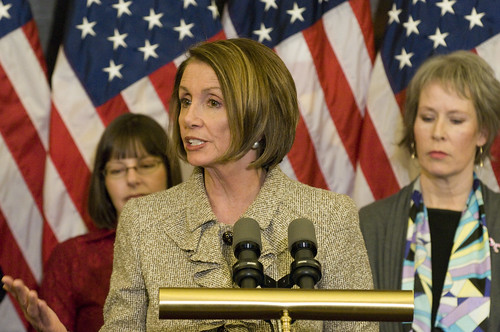
Speaker of the House Nancy Pelosi

The interminable march towards health care reform (HCR) is continuing in earnest today, with an end finally (FINALLY) in sight.  So what is actually happening right now?  And what's this "reconciliation" business all about?  There's no good way to sum up parliamentary procedures into a bite-size format, so bear with me, as this email will be long.  


Procedural Issues

In brief, the House of Representatives voted today on the HCR bill passed by the Senate in December.  The Senate bill, as you may have heard, includes some rather unsavory deals that were cut in order to win 60 votes and to pass the bill; deals such as the "Cornhusker Kickback" that was negotiated by Sen. Ben Nelson (D-NB) that would provide indefinite federal funding to cover the expected increase in Nebraska's Medicaid costs due to expanding coverage to more people (Medicaid is paid for in part by federal funds and in part by state funds, so any increase in Medicaid costs will cost the states directly).  The Kickback and other deals that were made for specific Senators in specific states to win their votes are obviously not terribly popular with rank-and-file Democrats, and so by the House voting for the Senate bill as it is, they made those Senate deals into law.

However, over the last few weeks President Obama, Nancy Pelosi, Harry Reid, and other key Democrats in both chambers of Congress have worked out a deal to pass a reconciliation bill that "fixes" all of the deals that were passed in the Senate bill and that will work to further reduce the deficit (the Congressional Budget Office, the main non-partisan arbiter of all things budgetary, has stated that the bill will reduce the federal deficit by $140 billion over the first 10 years it is in place and by $1.2 trillion over the second 10 years it's in place, although those numbers are subject to a large amount of skepticism on both sides).  This reconciliation bill will be voted on tonight by the House once the Senate bill is passed by the House, and then that reconciliation bill is supposed to be passed by the Senate, hopefully later this week, although the timing is debatable.  Members of the House are afraid that the Senate will seek to alter the reconciliation bill, upsetting the delicate balance that has been struck between leadership and the members, although Senate leadership has worked to reassure nervous House Democrats that the Senate will pass the bill as-is.  Any changes that are made in the Senate will have to be voted upon again by the House before President Obama can sign the bill, delaying the legislation further, an outcome Democrats are working to avoid.  

So is the use of reconciliation by the Democratic majority "unconstitutional" or a "nuclear" procedure, as Republicans have sought to portray it?  Well, considering that the majority of the uses of reconciliation have come when Republicans were the majority in Congress (16 out of 22 reconciliation bills) it seems a bit rich for Republicans to call it an extraordinary procedure now.

Finally, abortion.  A lot of hay has been made in the last few weeks about whether there is any federal funding of abortion in this HCR bill, and the fact is, there never was any federal money for funding abortions.  There is a provision in the House called the Hyde Amendment, that bans spending federal money on abortions, and the HCR bills that have been debated have always upheld that provision.  It has now been reported that President Obama has issued an Executive Order banning the use of federal money on abortions, as an extra safeguard, so thankfully, this argument is now moot.


Why I Support The Bill

The primary reason that I am in favor of passing this bill, despite the fact that it does not include the most effective cost-saving measures of either a public option or single-payer system, is that the bill enshrines in US law the fundamental concept that health care is a right, not a privilege.  For too long in this country, we have consigned our fellow Americans to suffer from treatable, often preventable illnesses and conditions by claiming that people have the "choice" to buy health insurance if they want it.  Sadly, the reality has never been quite so simple.  Two of the more significant reforms in this bill are those ending the denial of health insurance for those people with pre-existing conditions, and making illegal the use of rescission (where the insurer cancels your health insurance just when you need it most due to a usually dubious claim of "fraud" on your insurance application).  These two revisions alone will help keep far fewer people from going bankrupt due to medical care (click for shocking statistics).  

Consider the fact that if you receive your health insurance through your employer, as the vast majority of Americans do, what will you do if you lose your job?  You will have COBRA coverage for a few months, but generally COBRA is quite expensive, and moreover, it's temporary.  How many of you who are lucky enough to have jobs still are unwilling to leave a job that is no longer satisfying because you are afraid of losing your health insurance?  Is that lack of mobility not an impediment to your freedom?  Does not the health insurance system we have now foreclose upon choices that we would otherwise have if we were assured of health insurance?  Far from reducing our freedom as many opponents of the bill have claimed, this bill will greatly enhance freedom and will enhance job mobility.

For small business owners and entrepreneurs who would like to start out on their own, but are not able to afford exorbitant health insurance costs, this bill provides subsidies for health insurance for their employees.  Whereas the current system has skewed the benefits towards existing companies, and especially towards companies with large employee bases that can be insured under group plans, this bill begins to level the playing field between newer and more-established businesses, and between larger and smaller businesses.  

As a young person, I will be paying for this bill for the rest of my days, and despite that (in fact, because of that) I still support it.  I have faith that the bill will be improved, refined, expanded, and remade in time.  Young people are the linchpins upon which reform depends.  The reason we have coverage mandates in the bill is so that younger, healthier people (who tend not to buy health insurance) will be forced to buy insurance.  Younger people tend to have better health than the not-as-young, and because of that, it is unlikely that a young person will spend as much on health care as they pay in annual premiums.  The idea is that the insurance companies will shift those excess premium dollars (after shaving off a nice profit) to pay for more expensive people's health care, who may have spent more on care than they paid in premiums.  So they need us, which is a reason why the HCR bill has a provision that allows dependent children to be covered under their parents' health insurance plan until they're age 26.  As long as somebody's paying the premiums for their insurance and not costing insurance that much money on care, the insurance companies are happy.

Finally, I support this bill because even if you have insurance and you're happy with it, you already are paying for the uninsured.  In fact, you're paying quite a lot for the uninsured, and it'll only get worse unless something is done.  When a person does not have health insurance and gets sick, they'll probably wait until they're really sick and then go to the emergency room for treatment.  As everyone is surely well aware, emergency room treatment is the most expensive kind, and when patients can't pay the hospitals back for the care they've received, the hospitals then charge insurers more for patients with insurance, which leads to higher premiums for insurance, which more people can't pay, and so they become uninsured...the cycle goes on.  This bill is an attempt to stop that cycle.

It's not perfect by any stretch of the imagination, but this bill is far, far better than the status quo.  For more information, see the two links below, both by the non-partisan Kaiser Family Foundation's Health News:

Friday, February 26, 2010

More Highlight Videos from the Health Care Summit

I had said yesterday that President Obama came off well at the summit, and that the health insurance reform bill is actually quite moderate, and here's some video proof of that:


Yes, I'm a policy wonk, but this is a fascinating exchange, and well worth the 7.5 minutes to watch.  Obama explains just how difficult it is to craft reasonable health care regulations, since the government has to be responsive to industry concerns as well as those of individual consumers on what is an extremely personal topic.

Lastly, Speaker Nancy Pelosi courageously and valiantly stood up for the public option and called out Republican lies in regards to whether the reform bills allow for public funding of abortions and Medicare benefit cuts for seniors (neither are in either of the reform bills from the House or Senate.)  There have been egregiously misleading statements made about these bills by the GOP, statements that any person with an internet connection or access to a newspaper could very quickly refute, yet they continue to try to scare the public into opposition.  Bravo to Speaker Pelosi - see her in action below:


Thursday, December 17, 2009

Time to make banking boring again

Yes! Vindication is nigh! Well, that's what Simon Johnson at the Baseline Scenario thinks, anyways. Johnson is convinced that Paul Volcker will be victorious in his quest to re-regulate the banking industry, and dare I say it, make banking boring again through reinstituting the Glass-Steagall reforms. What a concept, right? It's funny to me that when I read classic fiction, the bankers are portrayed as the staid, conservative types, who are well-off, but never considered the captains of industry as they are today (well, except perhaps in The Great Gatsby). And what is humorous to me is that that classic image of the banker is very much divorced from the one we have witnessed over the past decade, when banking became one of the most, if not the most, freewheeling industries in terms of risks taken and sums of money made.

The topic of banking and financial reform has become quite compelling to me of late (as is clear from the substance of my recent posts) as I believe that the problems we are witnessing strike at the heart of the American approaches towards money and morality. "More is always better" is the stereotypical American ethos, and yet there should be consequences for wrong actions (witness America's continuing fascination with the death penalty as a form of crime control, despite widespread statistical studies that show the death penalty does not deter crime). However, the financial titans pursued wealth with a single-minded focus, playing with other peoples' money, and when the house of imaginary wealth they built came crashing down, they suffered few, if any, consequences. There is a basic unfairness to this matter, and a sense that the outrages will not stop, given the current weaknesses in the financial reform plans the House passed last week and that are now before the Senate (and sure to be watered down there even further). Johnson notes the fairness issue in the context of Volcker's proposed reform measures:
This strategy is partly about timing – and in this regard Volcker has chosen his moment well. The economy is starting to recover, but this process is clearly going to take a while and unemployment will stay high for the foreseeable future. At the same time, our biggest banks are making good money – mostly from trading, not much from lending to small business – and they are lining up to pay very big bonuses.
Not only is this contrast – high unemployment vs. bankers’ bonuses – annoying and unfair, it is also not good economics. Bankers are, in effect, being rewarded for taking the risks that created the global crisis and led to massive job losses. And they are being implicitly encouraged to do the same thing again.
And there's the rub; bankers are being incentivized, to use the economics term, to take massive short-term risks again if we keep the basic banking structure the way it has been since the repeal of Glass-Steagall. The bonuses will not stop, and the government will continue to be expected to backup the banks when they fail, because they've done it once, and the banks now have an incentive to ensure that in the future they will once again be "too-big-to-fail" so that the government will be forced to backstop their losses when the next recession hits. The core business of banking, saving and lending money, is being short-changed in what ought to be our country's economic recovery in favor of the massive profits (and risks) of the financial innovations of the past decade. Until Obama and his Administation get a grip on the need for fundamental reform and a return to the basics, the Wall Steeters will continue to put all of our nation's money in harm's way.
Reblog this post [with Zemanta]

Wednesday, December 16, 2009

Obama, Health Care Reform, and Corporate Chicanery: Capitulating the Battle and Losing the War

President George W. Bush and President-elect B...Image via Wikipedia
So health care reform is virtually over, the chance for progressives to win out and to really cut costs and inject competition into the health insurance market has passed, and the corporations won out again. As noted below, I was despairing earlier today, but after reading Bob Cesca's latest piece at Huffington Post, I feel slightly better. His main point is that, despite being truly, utterly pissed off about how things have transpired in the health care debate, there is too much still at stake to actually "kill the bill." To wit:
Yet I can't help but to believe that killing reform will only heap an even larger failure on top of losing the public option, the Medicare buy-in and so forth. Only this time, it won't be a failure limited to an ideological or political routing. The failure of health care reform will invariably mean at least another decade (if not two decades) of a desperate health care system in crisis. Another decade or two of medical bankruptcies and deaths due to a lack of insurance -- exponential premium hikes and rescissions. You know the list.
If I stop being pissed off long enough to take a good look at what remains in both the Senate and House bills, there aren't necessarily fool-proof solutions to these problems, but there are regulations, subsidies and reforms that will ameliorate a significant chunk of the present crisis. For example, the Senate bill will reduce the cost of insurance for a family of four earning $54,000 from around $19,000 per year to around $9,000 per year.
[snip]
Do progressives really want to tell working-and-middle class families of that they're not allowed to get a $10,000 annual break on their insurance payments? If you're okay with that, I admire and respect your integrity, but I just can't be a part of it. Objective reality dictates that there's no other path at this point but to support the bill and to subsequently endeavor to fix it.
So incremental reforms it is, but at least 30+ million additional Americans will have insurance coverage, despite having to pony up the cash to buy that insurance themselves. Let's hope those subsidies come through, and that they're generous...

But the larger issue here is a sense that our President is selling us out. He could have drawn a line in the sand and fought harder for the public option, rather than pay lip service to it to appease the liberal base. He could have fought for pharmaceutical reimportation from Canada to help save the US taxpayer over $100 billion over the next 10 years, as he had when he was a Senator, however he brought his considerable political weight down on the side of killing that reform effort in order to preserve his backroom deal with the pharmaceutical companies to preserve their profits as long as they did not work to destroy reform. Beyond health care reform, the sense that Barack Obama is not living up to be the President we voted for is also apparent in the "financial reform" efforts I wrote about earlier today, and Cenk Uygur writes passionately about that sense, laying out a concise summary of all that is disappointing about our President thus far. In brief:
But I don't put the civil liberties and the wars in the same equation as the other issues I mentioned. Why? Because it's one thing if I disagree with your policies and principles, if they are genuinely held. Ok, that's a sad day for me but doesn't necessarily indicate that you're wrong or unprincipled (no matter how much I might disagree with you). What I mind is the give-aways to corporate lobbyists that have nothing to do with your principles and have everything to do with politics and money. What I mind is when you sell out the American people to protect corporate America. I hate it when the Republicans do it and pretend to be for the little guy. And I hate it when this administration does it and pretends to be for change.
There was always going to be buyer's remorse when a huge portion of the voting public places their hopes and dreams in one man who must work within the system that is presented to him, however I don't think anyone expected the remorse to be quite this sharp, on so many issues of such great importance to our country. I hold out hope for a change from Obama, but hope is fading fast these days.

Reblog this post [with Zemanta]

UPDATED: Remember the Titans (of Industry are Not Friends of Yours)

Paul Volcker, former head of the Federal Reser...Image via Wikipedia
Allow me, if you will, to paint a layman's picture of the economic crisis and unbridled greed through the use of some headlines that have caught my eye in the last few days.

Headline 1: With Wall Street Shorting the Dollar, It is Time for Congress to Pursue Fundamental Change by David Paul, President of the Fiscal Strategies Group. This article provides some insight into how it is that Wall Street is managing to have one of its best years ever, despite the fact that the rest of the economy is in the grip of a major recession brought on largely by Wall Street's criminally risky behavior. Outrageously, after having been bailed out by US taxpayers, the banks are making their billions right now by shorting the US dollar and thereby effectively weakening the US' international position further than it would be otherwise. I won't excerpt from this article, as the entire piece is well worth a read, and has sadly been overlooked by the continuing popular outrage against the billion-dollar bonuses the banks intend to pay out this month, but suffice it to say that the banks are committing financial treason, if not outright treason, in pursuit of their profits at all costs.

UPDATE: Turns out that the Federal Reserve will allow the bet-against-the-dollar party to continue through the rest of the year by keeping the interest rate between 0% and 0.25%.  Sounds swell.

Headline 2: Obama Blasts Banks for Opposing Financial Reform: Here Obama comes out with some populist lines trying to get ahead of public sentiment against the excesses of the banks, and those banks ignore him, since he officially has no leverage over the banks' practices now that virtually all of them have paid back their TARP funds to the government. The banks are now free to continue to reduce business lending and to actively oppose any sort of reform that puts a damper on their radical activities. The lack of lending is slowing the economic recovery as businesses aren't able to hire workers as easily, and the banks know that they have the power to hamper any sort of recovery through cutting down on lending, effectively vetoing the President's initiatives from the private sector.

Headline 3: Bailout Banks Keep Tax Breaks As They Repay Loans: Yes, Citigroup and others are going to cash in on massive tax breaks, even as they repay the TARP funds that put caps on compensation practices early, to better engage in the type of compensation practices that preceded the economic collapse. The IRS appears, for all intents and purposes, to be in collusion with the banks on first glance, however by allowing for these tax breaks, the Treasury Department is actually increasing the value of the banks' shares, so that taxpayers get a better return on their TARP investments. Still, it's just an extremely sketchy way of going about increasing a company's worth, when the underlying fundamentals are still so weak. It is never a good thing for a company to rely on tax breaks to increase its value, rather than on sound business practices (say I who support tax breaks alternative-energy companies...)

All that being said, there appears to be hope on the horizon in terms of financial reform. Yes, the House passed a reform bill last week, but that effort was weakened by bank-friendly Democrats, and as noted in the above link, the Senate will now be the main battleground over financial reform going forward, with bank lobbyists gearing up for a major fight. But the Senators may have some tricks up their sleeves, and a voice from the past may play a larger role in the reform movement still to come.

Hopeful Headline 1: McCain and Cantwell Want a New Glass-Steagall Law by Michael Hirsh for Newsweek. Glass-Steagall is a post-Depression-era law that worked to separate the investment arms of banks from the commercial lending sides (what we know as the regular bank you set up checking and savings accounts with, and that provide loans for cars to homes). The idea behind Glass-Steagall is that the investment sides of banks can take the risks, but the lending sides should be more well-regulated, and they will be provided for by the newly-created Federal Deposit Insurance Corporation (FDIC) with the government as "lender of last resort" should a bank fail. With the 1999 repeal of Glass-Steagall, the banks were allowed to merge their lending and investment arms, and some, such as Sens. McCain and Cantwell, believe that the risky bets the banks took with depositors' money, such as derivatives, laid the groundwork for the mess we're in today. While I'm no economist (I've only taken one micro class thus far) and I'm certainly not a financial market expert, it would appear to me that if the banks could get back to their core business of banking that would be a welcome return for many. Which leads me to my next point...

Hopeful Headline 2: Paul Volcker: Think More Boldly and interview with the Wall Street Journal's Alan Murray. Paul Volcker, former Federal Reserve Chairman under Presidents Carter and Reagan, argues that the "financial innovations" Wall Street has foisted upon the world in the wake of Glass-Steagall's repeal add nothing in the way of actual productivity or economic growth in the economy as a whole. The titans of Wall Street created fake profits, and the financial innovations of credit-default swaps and collateralized debt obligations simply "move around the rents in the financial system" meaning the complex transactions that played out between banks and insurers (such as AIG) to spread the debts out amongst many different players. Volcker goes on:
How do I respond to a congressman who asks if the financial sector in the United States is so important that it generates 40% of all the profits in the country, 40%, after all of the bonuses and pay? Is it really a true reflection of the financial sector that it rose from 2½% of value added according to GNP numbers to 6½% in the last decade all of a sudden? Is that a reflection of all your financial innovation, or is it just a reflection of how much you pay? What about the effect of incentives on all our best young talent, particularly of a numerical kind, in the United States?

In Britain, I was just talking to a high-tech company about the immense attraction to go into finance when both Britain and the United States are suffering from a basic inability to produce things competitively, to keep up with the new economy. Is this a result of financial innovation that we should be really worried about?
These thoughts intrigued me; how much have the outsize profits to be had in finance over the last decade shaped the job market in the US? How many of our "best and brightest" have gone on to huge-paying Wall Street jobs that would have otherwise gone into less, ahem, financially-motivated work? Look at these graphs of US job growth over the past decade; what does it say about our country when the investment sector grows from 2.5% of GDP to 6.5% over 10 years, but job growth drops to near-zero percent over that same period of time? Is there a link, a correlation, a causation? My limited economic knowledge at this point in my education leads me to admit that I cannot find an explanation for those two inverse movements of financial-sector activities and job growth, but I would be greatly interested if someone could explain them to me.

Let me take a moment to plug a wonderful website I've just recently come across, The Baseline Scenario, which, I must acknowledge, led me to the Volcker interview in the first place.  Some very esteemed financial market watchers and economists evaluate the current economic situation and provide some solutions, in very detailed form. I'll do some more investigating into the jobs/financial sector expansion connection and report back when I can. The main idea I've come away with is that the American people are being misled and misrepresented by our public officials and big businesspeople all at the same time, on many levels. It pains me that Obama has not been more of a force for true reform, especially when the plundering of our nation's economy and public coffers has been so widespread and rampant by the titans of industry. There's still time yet to make some fundamental changes, and Volcker seems quite confident that his views will prevail, so let's hope the situation changes soon.
Reblog this post [with Zemanta]

Tuesday, December 15, 2009

UPDATE II: Health Care Reform to be Killed?

Updates below...

Today is a tough day across for liberals.  Whether that is a positive development in you opinion or not, health care reform is something that, if done right, could help so many people in so many ways that any setback in the reform movement should be cause for concern among many. The health care bill in the Senate has been diluted by special interests (read: moneyed interests) and their lackeys in Congress to the point where it appears to be more beneficial to the American people to simply start over with a fresh bill. Howard Dean, one of the foremost experts on health care in American politics today, argues to kill the bill too:
"This is essentially the collapse of health care reform in the United States Senate," Dean said. "Honestly the best thing to do right now is kill the Senate bill, go back to the House, start the reconciliation process, where you only need 51 votes and it would be a much simpler bill."
Ah yes, the specter of reconciliation rears its controversial head again. The main bone of contention amongst liberals is that the cost-saving measures (the public option, for instance) have been either weakened to the point of irrelevancy or stripped out entirely, so that enforcing a universal mandate for Americans to purchase insurance without adequately affordable options beyond private insurance will anger many citizens (and voters). A development on that level could be disastrous for the country's health care system and,in an electoral sense, for the Democrats more generally. The Obama Administration is interested in getting a bill passed, no matter what the cost, to ensure an electoral "win" for the President on his signature domestic initiative, health care reform, but the repercussions of a bad bill getting passed could reverberate for many years. As I had written earlier, if the reform bill falls too heavily on young people's pocketbooks, then you can be sure that their allegiance to Obama's policies will be quite fleeting, and in fact could result in a backlash. Let's hope that cooler heads prevail, and the rush to pass something doesn't overwhelm the desire to enact a more-perfect bill.

UPDATE: Timothy Noah of Slate has a key writeup of what health care reform's failure could mean for the American public, and it's not pretty, as contrary to what many have come to believe (myself included) the reform bill would have effects beyond the uninsured:
A reasonable summary would be: health reform would make life easier for just about every person who needs to buy his or her own health insurance. It would also reassure those of us in the lucky 59 percent who didn't have this problem but could easily imagine acquiring it, especially amid the current economic turmoil. That's just about everybody. Health reform lends, says Hacker, the "security of knowing there's somewhere to get insurance outside of employment." Should it fail to pass, you would not have that security.
As I've mentioned before, it's difficult to put a price on the security that comes with knowing that even if you were to lose your job you would be able to have health insurance at a relatively affordable price (that's what the subsidies are for).  This bill may not be everything liberals want, but this is still farther than the American people have ever come before, and the effect passing it would have would be humongous.  We can tweak it later, once 31 million fewer people are uninsured.

UPDATE II: Okay, now I'm depressed.  Glenn Greenwald of Salon argues that Obama is simply using the intransigence of the Senate, and especially Sen. Joe Lieberman, as a foil to enact the handout to the health insurance industry he always intended.  The argument is that the Democrats will reap the benefits of the healthcare industry's deep pockets for campaign donations down the road if they help out the industry now by not reforming too much.  Sad, sad, sad.  Industry is poised to win again against the needs and desires of average Americans.  Are we entering a new Gilded Age, or have we already been in one for the last decade or more?  More on that theme presently...
Reblog this post [with Zemanta]

Sunday, December 13, 2009

Where the jobs at?

Federal Reserve Chairman Ben Bernanke is up for confirmation to a second 4-year term right now, giving Congress the chance to ask some tough questions of him and to assess his job performance over the past 3 years. While one might imagine that a reputed "expert on the Great Depression" would be eager to spur job creation in the United States to help out the little guys, how disappointed would you be to find out you're dead wrong in that assumption? Not only is Bernanke not interested in using the substantial monetary might of the Fed to stimulate job creation, but his concern over the US' long-run deficit is such that he now is signaling to Congress that the members ought to consider cutting Social Security and Medicare. Let's think about this for a minute. The elderly who may have been fortunate enough to have 401ks have presumably had those savings wiped out in this financial crisis, and now Bernanke wants to cut those entitlements they've earned through years of hard work during their lives? For those who never had investments on the stock market, and are solely reliant upon Social Security and Medicare, reducing their benefits would have devastating effects. This is fair how?


Bernanke worked to assure the committee he had nothing against old people. "I'm not in any way advocating unfair treatment of the elderly, who have worked all their lives and certainly deserve our support and help, but if there are ways to restructure or strengthen these programs that reduce costs, I think that's extraordinarily important for us to try to achieve," he said.

So for those of us who have been working and contributing to Social Security for our own future someday, we're just supposed to sit back and take another cutback, all in the name of long-term fiscal "responsibility?" If there's ever an appropriate time for kicking the can down the road on an issue, now is that time when it comes to Social Security, as it is the backstop for a lot of people who are suffering these days. Social Security and Medicare are two of what economists call "automatic stabilizers" that "dampen fluctuations in real GDP without any explicit policy action by the government." What all that means is that the stabilizers kick in during recessions to help people (i.e. welfare or unemployment benefits) and taper off during better times (more people are employed, so fewer people receive unemployment). These stabilizers help to keep recessions from getting too bad because they funnel money to people who need it and thereby increase spending (keeping GDP, and hence, the economy as a whole up more than it would be without them). So yeah, let's just cut, cut, cut away!
Thankfully, Sen. Bernie Sanders of Vermont is on the case:
Sanders said he sees it for what it is. "That's the solution? To cut back on the middle class and the elderly? That only adds fuel to the fire," he said. "Look, let's be clear. The middle class in America today is collapsing. Within the confines of the Beltway, we don't talk about that too much. But that is the reality. It's not just unemployment or underemployment. People are working longer hours for lower wages. People are unable to send their kids to college. People are losing their homes. People's jobs are going to China. That is the reality."
Hmm, there seems to be a common theme of the middle class being under assault these days. What kind of future can we Millenials expect to have if the social safety net on which our society has relied for the past 60 years is being cut out from under us, string by string?