Showing posts with label Business. Show all posts

Thursday, June 3, 2010

UPDATED: Health care statistics, undermining health care debate?

Peter R. Orszag Director of the U.S. Congressi...
Peter Orszag
Image via Wikipedia
UPDATE: I had originally written this post based mainly off of the NY Times piece linked to below, coupled with my own knowledge of health care policy, but it seems that this article has sparked a vigorous debate in the blogosphere regarding just how accurate it's claims about the Dartmouth Health Atlas are.  I have edited parts of my post below to take into account new information, but for more, see Kevin Drum at Mother Jones, David Leonhardt at the NY Times, or the Dartmouth Health Atlas authors' response.  Needless to say, the situation is far more complex than the Times writers acknowledge, involving statistical analysis and the extrapolation of data.  More info below my blog posting.

____________________________________________________________

There's a fascinating article out today in the New York Times about a Dartmouth study on health care spending and the resultant health outcomes across hospitals, states, and regions of the U.S.  The study was used by the Obama Administration and Congressional Democrats to make the case for the efficacy of cutting health care spending while actually improving patients' health outcomes.  The article paints a picture of the Administration's efforts to sell their plan via the study:
Mr. Orszag even displayed maps produced by Dartmouth researchers that appeared to show where the waste in the system could be found. Beige meant hospitals and regions that offered good, efficient care; chocolate meant bad and inefficient.
The maps made reform seem relatively easy to many in Congress, some of whom demanded the administration simply trim the money Medicare pays to hospitals and doctors in the brown zones. The administration promised to seriously consider doing just that. (emphasis added)
Mr. Orszag is Peter Orszag, Budget Director of the Office of Management and Budget at the White House, and one of the primary cheerleaders for health care reform within the Administration.  Color-coded maps are like catnip to legislators eager to provide pseudo-intellectual cover for their legislative aims, as they can simply point to the maps to make their overly simplistic arguments to their constituents.  The idea that politicians would ever think that health care reform is easy is truly scary.  We really need more economists and statisticians in Congress.
But while the research compiled in the Dartmouth Atlas of Health Care has been widely interpreted as showing the country’s best and worst care, the Dartmouth researchers themselves acknowledged in interviews that in fact it mainly shows the varying costs of care in the government’s Medicare program. Measures of the quality of care are not part of the formula. (emphasis added)
Did you catch that?  The Dartmouth study solely looks at the cost of care, not the quality of care, yet somehow or another the link between lower spending and better care was made by policymakers in Washington.  How did that happen?

In addition to their hospital rankings, the Dartmouth researchers have also done separate studies of how Medicare spending affects patient care regionally. A 2003 study found that patients who lived in places most expensive for the Medicare program received no better care than those who lived in cheaper areas.
Because some regions spent nearly a third more than other regions without any apparent benefit, the Dartmouth team concluded that at least one dollar in three was wasted by Medicare. When applied generally to the nation’s health care system, that meant about $700 billion could be saved.
But as it began publicly discussing its research, the Dartmouth team often extrapolated beyond this basic finding. Not only do high-spending regions fail to provide better care, the Dartmouth team began to argue, but those regions actually offer worse care. 
While I haven't seen the exact data the Dartmouth team examined in making these claims, the argument that one-third of Medicare spending is wasteful seems like a rather large extrapolation to make.  The blunt instrument of health care spending statistics does not lend itself to nuanced analyses of the quality of doctors or nurses at a hospital or of their clinical judgments in deciding what treatments to order for patients.

Last year, New Yorker writer (and practicing doctor) Atul Gawande wrote a major article about McAllen, Texas, the city with the highest per-capita Medicare spending in the country after Miami, a city with a much higher cost-of-living and more elderly population.  Gawande describes a meeting he has with a group of McAllen doctors, one of whom responds to Gawande's inquiry about the high spending thusly:
“Come on,” the general surgeon finally said. “We all know these arguments are bullshit. There is overutilization here, pure and simple.” Doctors, he said, were racking up charges with extra tests, services, and procedures. 
The surgeon came to McAllen in the mid-nineties, and since then, he said, “the way to practice medicine has changed completely. Before, it was about how to do a good job. Now it is about ‘How much will you benefit?’ ”
Naturally, when the incentives for doctors are to over-prescribe treatments so that they are compensated, they will tend to run more tests than necessary, and to focus on moving their patients into the more expensive treatment programs, rather than lower-cost preventive medicine treatments, which may be more effective.  So when the Dartmouth researchers make the arguments that higher cost equates to worse outcomes, that may indeed be true, as more health care does not always mean better health care, but it cannot be the case universally across the country.  If a doctor correctly diagnoses a serious ailment, and prescribes a necessarily expensive treatment regimen for it, then simply looking at the spending figures will not be able to take into account the correct diagnosis of that ailment.
In interviews, Dr. Fisher and Mr. Skinner acknowledged that there was no proven link between greater spending and worse health outcomes. And Dr. Fisher acknowledged the apparent inconsistency between his statements in interviews with The New York Times and those made elsewhere, saying that he was sometimes less careful in discussing his team’s research than he should be.
In any case, the more-is-worse message has resonated with insurers, whose foundations now help to finance the Dartmouth Atlas. Dartmouth researchers also created a company, Health Dialog, to consult for insurers and others on Dartmouth’s findings. Valued at nearly $800 million, the company was sold to a British insurer in 2007 and still helps to finance the Dartmouth work.
It appears that, surprise, if as a researcher you make arguments that resonate with insurance companies, they will take a financial interest in your research.

Ultimately, the problem here is twofold: 1) high per capita Medicare spending in an area may signify the overutilization of care by doctors, but to make the conclusion that higher spending is always wasteful goes too far; 2) researchers and academics who create studies that fit neatly into the narrative that the powers-that-be seek to promulgate (in this case the Obama Administration and the health insurers) will have their conclusions amplified, despite arguments to the contrary.  This resulted in the further muddying of the already opaque health care reform discourse in which nothing is quite as cut-and-dry as we might wish.  While I still believe the reform bill was a good step towards a healthier America, it's unfortunate that the system has been gamed by so many parties.

UPDATE, cont...Further muddying of the waters:
3. Some research has shown that even the most glaring cost
differences noted in the Dartmouth research are associated with
improved outcomes for those conditions where something close to random
assignment of patients to alternative patient regimes occurs. The guy
who is doing this work is Joseph Doyle at MIT. If the Times article
had described some of his work, readers would have learned something.
For example, you can be pretty sure that people who suffer coronaries
while on vacation do not choose in which county to have the heart
attack. Doyle studied such patients. He found that they did better
in Florida counties that spent most, the very counties that the
Dartmouth folks have held up for their poor average outcomes.
He also
found that preemies who were a couple of grams under the threshold at
which they are described as in need of intensive care did materially
better than did preemies a couple of grams over that threshold and,
hence, treated as normal births. The weight difference was too small
to matter medically and went in the wrong direction; the intensity of
care mattered.
Doyle's reasearch and the finding on the inverse relationship between
Medicare spending and private spending, together with the fact that we
can't predict worth crap who will and who will not benefits from many
procedures means not that the Dartmouth people are wrong, but that any
savings will be very hard to achieve without doing more harm than good
and will be very slow in coming. The Administration, and Orszag in
particular, were wrong in neglecting the warning to forecasters of
Scottish economist, Alec Cairncross, 'Give a number. Or a date.
Never both.'

Monday, May 10, 2010

The future of finance?

My schedule has not permitted me to post anything fully-developed for quite a while, but tonight I have a few multimedia treats for you, building off of the news themes of recent weeks.

First off, "Quants, The Alchemists of Wall Street."  A film made about the mathematical geniuses who created the models that have been largely running the financial world for a number of years now.  While that may not sound like the most interesting subject matter, I highly recommend taking 45 minutes and watching the film, there's lots to learn:


I thought this was an interesting little film as it stood, however the second half takes a surprisingly prescient turn in that the interviewees (or "quants," short for "quantitative thinkers," I assume) begin to discuss "high frequency trading," a term that sprang into the wider international consciousness following last Thursday's as-yet-unexplained 1,000 point drop in the Dow.  The idea of high frequency trading (or HFT) is that arrays of computers are set up to catch any variations in a stock's price that exceed or fall below certain parameters, or that follow Google search terms and will buy or sell stocks based on what's "hot" on Google at that moment.  Those parameters are set by mathematical models created by quants.

There are a host of scary implications that result from high frequency trading (not least of which is that these computers essentially set up parallel market structures that operate outside of public scrutiny) however there is a somewhat more mundane detail that the film raised that I'd like to focus on.

One of the quants notes that the NYSE is going to be (or perhaps already has by this point) setting up a warehouse in New Jersey that will house huge arrays of computers, each belonging to the various financial firms, where they will engage in further HFT.  The idea is that the computers will be closer to the NYSE than before, and therefore they will have a faster data connection to the stock market.  A further implication is that certain firms will get "privileged" connections that will afford them a tenth of a second advantage over the other firms; how those firms are chosen, be it through lottery or through financial transactions with the NYSE (read: bribes), is unclear.

There are certain industries in the world that are capital-intensive, in the sense that those industries required a large amount of resources, be it money, physical inputs, or large areas of land, to operate.  Steel is a capital-intensive industry, as is telecommunications, which requires the development of a significant amount of infrastructure to operate.  Clearly the world of finance is a capital-intensive industry, as a firm generally requires large amounts of money to operate, however "boutique firms" have always existed that were able to operate with smaller amounts of cash.  With this impending shift to a computer- and geographically-dominated business model, I wonder if finance is becoming more capital-intensive too?

Consider that if you're a small player, you're going to be forever outmaneuvered by the big firms who have prime locations for the fastest connections for their computer servers in New Jersey, plus offices full of top-quality quants figuring out the most accurate (or at least, the least wrong) algorithms that are then fed into the computer systems constantly.  How is a small firm supposed to compete against that?  This sort of situation can only lead to further consolidation of the financial sector into fewer firms controlling more of the wealth in this country.  As I discussed in my previous post, further consolidation of wealth is a very bad thing indeed.
__________________________________________________________________________________

And now for something only slightly different...

A further interesting implication of the film was the concept put forth by a couple of the quants that economists in recent years have begun to regard themselves as "scientists;" that their models predicting financial market movements and concepts were "laws" that would be proven correct no matter the circumstances.  This, despite the fact that economics has, since its inception, been considered to be one of the social sciences, these economists who were running the world of finance believed themselves to be masters of the financial universe.

There is a small problem with the underpinnings of these economists' views of the world, however: humans are messy.  To the extent that any sort of "science" is based on looking at human behavior in the aggregate there will always be room for inputs that simply break one's perfectly-calibrated model of the world.  So to the extent that finance is based off of the actions of many individual stock traders and firms run by financiers, perhaps it, too, should be considered a social science?  At least the world of theoretical finance, such as the world in which these quants operated should be, as they're modeling human actions in the aggregate, much in the same way that economists do.  Therefore, as even the quants recognize in the film, their models may not have failed, but the ways that the models were used and manipulated by the non-quant stock traders to make money is at least one part of what contributed to the financial meltdown in 2008.  Humans are unpredictable, and while it's a valiant effort to try to model human behavior, the more I read and the more I learn, the more futile, ultimately, I think it may be.  Just a small observation...

__________________________________________________________________________________

Finally tonight, the terrible, terrible story of what happens when the financial markets run out of subprime mortgages to invest in: they turn to "commodities."  Commodities markets trade derivatives of actual, physical goods, such as corn/maize futures, oil futures, or gold.  I don't wish to get into how the derivatives contracts work (partly because this post is already long enough and partly due to the fact that they're bloody complicated) but suffice it to say that firms betting on the futures markets can drive the prices of commodities up in a way that is completely unrelated to the underlying supply and demand fundamentals of that commodity.  Witness the continued high price of oil despite the fact that oil consumption is the lowest its been in years (see the link above for more on that).

These effects can be devastating for the poor and middle classes around the world, and sadly, the financial reform bills currently being debated in the Senate may do little to nothing to halt the devastation.

For Rounds 2 and 3 of the feature films tonight, I bring you an interview with Indian economist Jayati Ghosh, who explains to us that when finance gets its hands on the very food you seek to feed your family with, prices often will go up, to everyone's detriment.  This interview will infuriate you, and you'll want to yell at your computer screen "how can humans be so immoral as to create food bubbles and starve the poor???"  Well having seen "Quants" now, and gaining a bit of access into the mind of the modern financial mathematician, I can see, to an extent, how that might happen.  When you're dealing only in abstract numbers, looking for the most promising market to invest in, with no concept of the fact that your actions will increase the price of corn to be used for tortillas in the slums of Mexico, then it's very easy to buy into that bubble.  Does modern finance add any social value to our society?  It's really hard to tell these days, but I guarantee I'll come back to that theme.

Part 1:


Part 2:


I have been working on more complex postings having to do with the nature of the financial/political nexus that has developed and subsumed our political life in this country, and I hope to post those soon.  Furthermore, the oil spill in the Gulf of Mexico and the Greek debt crisis are all fodder for future postings, if there's time...

Friday, April 16, 2010

The Continuing Scourge of Too Big To Fail

WASHINGTON -  APRIL 9:  In this handout image ...Image by Getty Images via Daylife
I had the distinct pleasure of hearing Simon Johnson, an economist and professor of entrepreneurship at MIT's Sloan School of Business (and former Chief Economist for the International Monetary Fund) speak last night at a wonderful event produced by Zocalo Public Square, a local LA non-profit public affairs forum.  Johnson also is the author (with James Kwak) of the recently published 13 Bankers, about the financial crisis and how to stop another crisis from occurring again, and blogs at the Baseline Scenario, a blog I've been following for months and have linked to several times previously.

Johnson spoke quite emphatically about the need for fundamental financial reform, not as a partisan of any stripe (indeed, he claims to be a free-marketer more than anything else) but because the current financial system we have is not actually "capitalism" per se.  Why is that?  Well the phrase "too big to fail" (TBTF) signifies the problem at the center of our financial crisis, and within TBTF lies the potentiality for a future crisis even larger than the current one.  

First of all, what is "too big to fail"?  While we've certainly all heard the term bandied about since September 2008, I imagine there is some confusion out there.  The concept is that the financial institutions that were bailed out through the Troubled Assets Relief Program (TARP) instituted by former Treasury Secretary Hank Paulson, Federal Reserve Chair Ben Bernanke, and President Bush, among others, simply held too many assets in our economy, and were too interconnected, to be allowed to declare bankruptcy.  If the financial institutions (banks, such as Bank of America, and investment houses, such as Goldman Sachs) were allowed to fail, as Lehman Brothers was, then those failures would lead to an unprecedented breakdown of the global financial markets.  Furthermore, due to the interconnectedness of the various players in the markets, the thinking goes, the failure of one of the financial institutions could lead to the failure of others.  Why the institutions were all so interconnected is perhaps beyond the scope of what I'd like to say here today (in interests of length), but suffice it to say that AIG is one of the primary sources of the interconnectedness, and Goldman Sachs is another.

How did we get to this point where the banks were so big and interconnected that they could not fail without bringing down the global economy?  Well, I could try to explain, but I think I'll let Prof. Johnson explain, with the help of Steven Colbert:

The Colbert ReportMon - Thurs 11:30pm / 10:30c
Simon Johnson
www.colbertnation.com
Colbert Report Full EpisodesPolitical HumorFox News

Prof. Johnson raises a few points that are worth elucidating in that segment; first of all, the idea that the TBTF banks have an incentive to act recklessly and to take foolish risks with their investors' money.  This concept is known in economics terms as "moral hazard," and is essentially the idea that if you have a guarantee that the risks you face have been either eliminated or severely reduced by another party, then you will be inclined to take larger risks than you would without that guarantee.  Take, for instance, driving a car without auto insurance versus driving with auto insurance; you're likely to drive far more slowly and carefully without insurance than you would with insurance, because with your insurer's guarantee that they'll pick up any financial losses you incur through poor driving, you are not "on the hook" for your mistakes in the same way you would be without insurance.

The implicit backing of the government that came with the TARP bailouts of the largest financial sector players creates a moral hazard scenario in just the same way.  If a TBTF investment firm received a government bailout, then the individual managers and employees at that firm will be liable to take risks that they would not otherwise, as whatever they do, the government will ensure that their poor decisions don't cause the firm to go bust.  So, far from reducing the incentives of financial firms to reduce their exposure to risky investments, the bailouts in fact increased the incentives of firms to take massive risks, and to leave taxpayers to foot the bill.

A second point to discuss that is a corollary to the first (and which Johnson spoke at length about last night) is that the TBTF firms, with their implicit government backing, are receiving preferential treatment in the financial markets that are creating advantages for the banks to become even larger.  Essentially, because the government will not allow the TBTF firms to fail, they receive reduced interest rates when borrowing from private lenders.  Because the lenders perceive the TBTF firms as "safer" investments than firms that don't have government backing, they are willing to reduce the interest rates they charge the TBTF firms compared to other firms.  Naturally, this situation distorts the market's functioning, and gives the TBTF firms an advantage over their competitors that allows them to gain even larger market shares.  Hence, the failure of capitalism due to government intervention in the marketplace.  Johnson estimated the interest rates of the TBTF firms were reduced by approximately .7-.9% compared to their non-TBTF competitors, which may not sound like much, but when applied to loans and trades of billions of dollars at a time, those fractions of percents add up to large sums of money.  

So what is Prof. Johnson's solution?  To break up the TBTF firms into smaller, more manageable (and less economically dangerous) firms.  Johnson and a number of other significant economists estimate that a $100 billion limit on total assets under a firm's control is an ideal target to aim for.  What does that figure mean?  Well the current combined holdings of Bank of America, JP Morgan Chase, Citigroup, and Wells Fargo are approximately $7.4 trillion, and there are 23 institutions in the US that have assets over $100 billion.  Therefore, there will have to be a lot of division of these large institutions into smaller ones (simple arithmetic reveals that the $7.4 trillion of the four megabanks noted above, if divided into $100 billion sub-banks, would create 74 new institutions) and it is in the process of "breaking up" the banks that a lot of complication will occur, as in any complex transaction.  Furthermore, these firms are all multi-national, meaning that the US acting alone will not achieve any significant regulatory reforms unless those reforms are accompanied by international agreements.  It will be difficult enough for Congress to pass any semblance of meaningful financial reform (as evidenced by the Republicans' continued obstinacy) without having to deal with cross-border issues as well.  

I think I'll stop there for now.  There is still lots more to discuss about the financial crisis, as my understanding of the causes and the (proposed) solutions has been growing and evolving rapidly in recent months, and I'm eager to share what I've gained with you, my readers.  Despite not being a "finance guy" in the least, I believe that the simple fact that our financial sector has become such an integral part of the world economy requires that I attempt to understand what happened and how to prevent a recession of similar scale from ever happening again.  Any understanding I gain I'll attempt to pass on, since it's such a complex topic, but worthy of understanding by many.

In this posting I've focused only on the TBTF firms and the threats they pose to the financial markets and the world economy.  In future postings, I'll look at the political implications of such concentrations of wealth and power, as well as how it is that the financial sector got to have such power and influence as it does today.  If you have any further questions or a need for clarifications (or if I've totally bungled some facts in this posting) please comment on this piece below, or email me at generationalnavelgazing -at- gmail dot com (trying to protect my account from spammers, you know).

Additional programming note: I plan on returning to the subject of the Tea Party movement soon in an additional posting following up on my post from two weeks ago, so stay tuned for that.

Friday, April 2, 2010

To drill or not to drill, that is the question, baby

President Obama announced a new energy policy proposal yesterday, which appears to have surprised both environmentalists and fossil fuel interests in that the proposal seeks to open vast new areas of US coastline for offshore oil drilling.  The new drilling is combined with new regulations and policies to invest significantly in green energy resources, including new auto regulations mandating higher fuel economy standards of 35.5 miles per gallon across a company's entire fleet of cars and trucks by 2016.

But ultimately, nobody's really paying attention to the higher fuel economy standards, despite the very positive climate benefits those standards will have, when the topic du jour is offshore drilling.  Did the President really just give in to the "drill baby drill" crowd?

Well, I would argue that the answer is yes and no.  The President has just deftly given the Republican party, and its oil and gas interest supporters, enough rope with which to hang themselves, policy-wise.  Take a look at the chart below, helpfully supplied by the NY Times:

Copyright 2009 New York Times


All of the state coastlines that are now opened to new offshore drilling have Republican governors, except for Maryland, Delaware, and North Carolina.  Meanwhile, the areas north of Delaware on the Atlantic side, and all of the Pacific coast will remain off-limits to drilling, with the environmentally sensitive Bristol Bay in Alaska that was opened for exploration by President Bush now closed off for at least seven years.

The way I read it is, if Republicans want to drill so badly then let them, for as others have noted, allowing them to do what they have claimed offshore drilling would do - completely solve America's oil needs indefinitely - will be shown to be false.  Offshore drilling, because it has been anathema to environmentalists, has been built up to mythical status among Republicans, when any responsible politician would admit that there likely won't be enough oil to supply the US for long, and even then, the new oil will not affect gas prices at the pump.  The government lease and exploration process will take years, and then the companies that purchase the leases will need to actually extract and refine the oil, so don't expect any new "homegrown" oil for at least 10 years.

But that scenario only plays out if everything goes smoothly on the political end of things, and when does that ever happen?
Access to oil and gas in South Atlantic waters also would probably meet stiff resistance from the coastal states unless Congress first enacts a plan to share the billions of dollars in potential revenue from lease sales and oil and gas development. And that's not easy.
Lawmakers from coastal states that would benefit have been pushing for that, but some other senators argue that proceeds from oil and gas resources in federal waters should go to the U.S. Treasury.
Here's the thing, the governors will likely take a lot of flak from environmental and concerned citizens' groups from within their states if they agree to allow the offshore drilling, no matter where on the political spectrum they are.  What would help the governors neutralize that criticism is the prospect of increased state revenues from oil and gas development to help their states, but Congress would have to approve those deals.  Politicians never like to give up "free" money coming to their states at the expense of other states, so it would be quite a battle between the interior-state politicians and the coastal-state ones over who receives the proceeds from oil and gas development.  Hmm, divide and conquer, Mr. President?

Then there's the idea that Americans appear to have that any oil that is drilled from US territory by a multinational corporation like Exxon Mobil will automatically be sold in the US.  This is just wrong.  Oil drilled in the US will be shipped to wherever the demand is greatest in the world, just as oil is now.  While the US is currently a major consumer of oil in the world, who is to say that the oil drilled here won't be shipped to China instead?  In a few years the Chinese economy will only have grown further, so it isn't beyond the realm of possibility.

So all in all, what should we take away from these developments?  I believe this report from Kate Sheppard at Mother Jones provides a clue:
Environmentalists are not just angry that Obama is giving away the store on oil and gas drilling, they also feel that he's basing his decision on a dubious premise—that more drilling will enhance the nation's energy security. The US currently imports 57 percent of its oil, according to the Energy Information Administration. The nation accounts for 23 percent of total world oil consumption, but has only 3 percent the world’s oil reserves within its borders. Drilling off every coast in the US won’t resolve that issue. Even the most productive portion of the area opened to drilling, the eastern Gulf, is expected to yield only 3.5 billion barrels of oil. The US consumes 19.5 million barrels of oil per day, which means that these wells would only produce about 180 days worth of oil. And at current global oil prices, recoverable American-produced petroleum isn't likely to be cost-competive. (emphasis added)
Did you catch that?  For any offshore drilling to occur in this country, the oil companies have to actually believe that there is enough oil for them to recover before they make any capital investments.  It's dubious whether a sufficient amount of oil exists in these newly-opened areas to make it worth the oil companies' while to drill.  And therein lies the rub - President Obama just gave the Republicans and oil companies the access to offshore oil wells that they've been clamoring for for years, and now they're going to have to work to roll back Americans' expectations of just how much oil there is within our borders.  Republicans will have to explain to Americans that just because oil companies now can drill offshore, gas prices will not drop back to $1.50/gallon, indeed:
"Where are the Republicans out there talking about how crude is going to go down" when drilling is allowed, "because oil certainly isn't reacting to it today," said Michael Masters, a hedge fund manager who's testified repeatedly before Congress that big inflows of investment dollars are driving up oil prices, not supply shortages. "It's not a supply and demand issue. ... Crude is detached from the fundamentals."
Masters is referring to oil futures markets, where speculators have notoriously been driving up the price of oil for years now, apart from any increase or decrease in production.

So Obama has managed (it appears thus far, anyways) to divide Republicans on oil drilling, while simultaneously putting them on the defensive regarding their previous claims of the amount of oil the US truly has within its borders.  With the Trojan Horse of offshore drilling, Obama managed to slip by the first increase in vehicle mileage standards in nearly 30 years, a move that on any other day would have provoked howls of protest from the Republican side of the aisle.  On balance, it appears that the positive environmental effects of the new vehicle mileage standards regulations may well outweigh the negatives of offshore oil drilling, but Obama was able to distract the other side (and much of the media) from noticing with the shiny, glossy offshore drilling announcement.

And as for the environmentalists, well I noticed a curious coincidence regarding two of the largest environmental organizations, the Sierra Club and Greenpeace, see if you notice a certain similarity:
"Is this President Obama's clean energy plan or Palin's drill baby drill campaign?" quipped Greenpeace Executive Director Phil Radford in a statement on Wednesday.
“Drilling our coasts will do nothing to lower gas prices or create energy independence,” Michael Brune, executive director of the Sierra Club, said in a statement. It will only jeopardize beaches, marine life, and coastal tourist economies, all so the oil industry can make a short-term profit.” (emphases added)
So both Greenpeace and the Sierra Club released statements, indicating that they were notified ahead of time about the drilling plans, and taking a look at their websites (Greenpeace, Sierra Club) there was either no mention of Obama's announcement on the Sierra Club website, or just a rather rote statement from Greenpeace's Executive Director.  If this plan were so terrible, wouldn't the greens be shouting into any TV camera they could find about how terrible it is?  Could it be that they're in cahoots with the President on a strategy to mollify the "drill baby drillers" while the actually environmentally progressive legislation gets passed in the background?  I think that the President and the enviros are betting that in the time it takes for any sort of viable oil drilling operations to get set up offshore, the US would have already begun the transition towards alternative fuels, obviating the need for major drilling operations at massive costs.  Also, the Bristol Bay area that has now reverted back to protected status in the Obama plan was a key sticking point with environmentalists, so it's not as though they lost out entirely.  But then again, I could be totally wrong.  I just find the curiosities of this particular announcement and the context surrounding it too intriguing not to try to suss it out.  Time will tell.

Sunday, March 21, 2010

Why I Support The Health Insurance Reform Bill


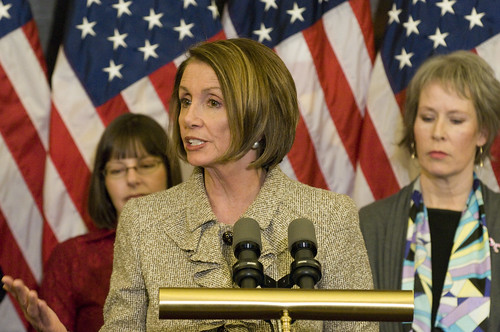
Speaker of the House Nancy Pelosi

The interminable march towards health care reform (HCR) is continuing in earnest today, with an end finally (FINALLY) in sight.  So what is actually happening right now?  And what's this "reconciliation" business all about?  There's no good way to sum up parliamentary procedures into a bite-size format, so bear with me, as this email will be long.  


Procedural Issues

In brief, the House of Representatives voted today on the HCR bill passed by the Senate in December.  The Senate bill, as you may have heard, includes some rather unsavory deals that were cut in order to win 60 votes and to pass the bill; deals such as the "Cornhusker Kickback" that was negotiated by Sen. Ben Nelson (D-NB) that would provide indefinite federal funding to cover the expected increase in Nebraska's Medicaid costs due to expanding coverage to more people (Medicaid is paid for in part by federal funds and in part by state funds, so any increase in Medicaid costs will cost the states directly).  The Kickback and other deals that were made for specific Senators in specific states to win their votes are obviously not terribly popular with rank-and-file Democrats, and so by the House voting for the Senate bill as it is, they made those Senate deals into law.

However, over the last few weeks President Obama, Nancy Pelosi, Harry Reid, and other key Democrats in both chambers of Congress have worked out a deal to pass a reconciliation bill that "fixes" all of the deals that were passed in the Senate bill and that will work to further reduce the deficit (the Congressional Budget Office, the main non-partisan arbiter of all things budgetary, has stated that the bill will reduce the federal deficit by $140 billion over the first 10 years it is in place and by $1.2 trillion over the second 10 years it's in place, although those numbers are subject to a large amount of skepticism on both sides).  This reconciliation bill will be voted on tonight by the House once the Senate bill is passed by the House, and then that reconciliation bill is supposed to be passed by the Senate, hopefully later this week, although the timing is debatable.  Members of the House are afraid that the Senate will seek to alter the reconciliation bill, upsetting the delicate balance that has been struck between leadership and the members, although Senate leadership has worked to reassure nervous House Democrats that the Senate will pass the bill as-is.  Any changes that are made in the Senate will have to be voted upon again by the House before President Obama can sign the bill, delaying the legislation further, an outcome Democrats are working to avoid.  

So is the use of reconciliation by the Democratic majority "unconstitutional" or a "nuclear" procedure, as Republicans have sought to portray it?  Well, considering that the majority of the uses of reconciliation have come when Republicans were the majority in Congress (16 out of 22 reconciliation bills) it seems a bit rich for Republicans to call it an extraordinary procedure now.

Finally, abortion.  A lot of hay has been made in the last few weeks about whether there is any federal funding of abortion in this HCR bill, and the fact is, there never was any federal money for funding abortions.  There is a provision in the House called the Hyde Amendment, that bans spending federal money on abortions, and the HCR bills that have been debated have always upheld that provision.  It has now been reported that President Obama has issued an Executive Order banning the use of federal money on abortions, as an extra safeguard, so thankfully, this argument is now moot.


Why I Support The Bill

The primary reason that I am in favor of passing this bill, despite the fact that it does not include the most effective cost-saving measures of either a public option or single-payer system, is that the bill enshrines in US law the fundamental concept that health care is a right, not a privilege.  For too long in this country, we have consigned our fellow Americans to suffer from treatable, often preventable illnesses and conditions by claiming that people have the "choice" to buy health insurance if they want it.  Sadly, the reality has never been quite so simple.  Two of the more significant reforms in this bill are those ending the denial of health insurance for those people with pre-existing conditions, and making illegal the use of rescission (where the insurer cancels your health insurance just when you need it most due to a usually dubious claim of "fraud" on your insurance application).  These two revisions alone will help keep far fewer people from going bankrupt due to medical care (click for shocking statistics).  

Consider the fact that if you receive your health insurance through your employer, as the vast majority of Americans do, what will you do if you lose your job?  You will have COBRA coverage for a few months, but generally COBRA is quite expensive, and moreover, it's temporary.  How many of you who are lucky enough to have jobs still are unwilling to leave a job that is no longer satisfying because you are afraid of losing your health insurance?  Is that lack of mobility not an impediment to your freedom?  Does not the health insurance system we have now foreclose upon choices that we would otherwise have if we were assured of health insurance?  Far from reducing our freedom as many opponents of the bill have claimed, this bill will greatly enhance freedom and will enhance job mobility.

For small business owners and entrepreneurs who would like to start out on their own, but are not able to afford exorbitant health insurance costs, this bill provides subsidies for health insurance for their employees.  Whereas the current system has skewed the benefits towards existing companies, and especially towards companies with large employee bases that can be insured under group plans, this bill begins to level the playing field between newer and more-established businesses, and between larger and smaller businesses.  

As a young person, I will be paying for this bill for the rest of my days, and despite that (in fact, because of that) I still support it.  I have faith that the bill will be improved, refined, expanded, and remade in time.  Young people are the linchpins upon which reform depends.  The reason we have coverage mandates in the bill is so that younger, healthier people (who tend not to buy health insurance) will be forced to buy insurance.  Younger people tend to have better health than the not-as-young, and because of that, it is unlikely that a young person will spend as much on health care as they pay in annual premiums.  The idea is that the insurance companies will shift those excess premium dollars (after shaving off a nice profit) to pay for more expensive people's health care, who may have spent more on care than they paid in premiums.  So they need us, which is a reason why the HCR bill has a provision that allows dependent children to be covered under their parents' health insurance plan until they're age 26.  As long as somebody's paying the premiums for their insurance and not costing insurance that much money on care, the insurance companies are happy.

Finally, I support this bill because even if you have insurance and you're happy with it, you already are paying for the uninsured.  In fact, you're paying quite a lot for the uninsured, and it'll only get worse unless something is done.  When a person does not have health insurance and gets sick, they'll probably wait until they're really sick and then go to the emergency room for treatment.  As everyone is surely well aware, emergency room treatment is the most expensive kind, and when patients can't pay the hospitals back for the care they've received, the hospitals then charge insurers more for patients with insurance, which leads to higher premiums for insurance, which more people can't pay, and so they become uninsured...the cycle goes on.  This bill is an attempt to stop that cycle.

It's not perfect by any stretch of the imagination, but this bill is far, far better than the status quo.  For more information, see the two links below, both by the non-partisan Kaiser Family Foundation's Health News:

Saturday, December 19, 2009

Money in Washington, or, How the Democrats Became Beholden to Business Interests

US journalist and commentator Bill MoyersImage via Wikipedia
Bill Moyers, who recently announced he will be retiring from weekly television to our collective detriment, shows that his style of intrepid journalism still makes for must-see-TV with his Friday episode of Bill Moyers Journal. Moyers interviews The American Prospect's Robert Kuttner and Rolling Stone's Matt Taibbi on the Obama Administration's various capitulations to the wills of monied interests from health care to financial reform. If you would like a succinct and informative look at how things have gone so wrong so quickly in Obama's still-young Administration, I highly recommend you take half an hour and watch the program. Hat tip to CitizenofEarth on DailyKos for drawing my (and others') attention to this episode.
In the Moyers discussion, Taibbi makes the argument that the Democrats, and especially Rahm Emanuel, Obama's Chief of Staff, have made a business decision to win the fundraising battle with Republicans by appeasing business interests:
And I think, you know, a lot of what the Democrats are doing, they don't make sense if you look at it from an objective point of view, but if you look at it as a business strategy- if you look at the Democratic Party as a business, and their job is basically to raise campaign funds and to stay in power, what they do makes a lot of sense. They have a consistent strategy which involves negotiating a fine line between sentiment on the left and the interests of the industries that they're out there to protect. And they've always, kind of, taken that fork in the road and gone right down the middle of the line. And they're doing that with this health care bill and that's- it's consistent.
In a sense, a connection can be seen between the health insurance industry's business model and the "business model" of modern politics: the only way to make profits is to deny the people who use your services the services that they have rightfully paid for, with that payment being, in this case, insurance premiums, votes, or public opinion. For instance, the insurance industry can use rescission and other nefarious tactics to deny health care to people when they need it most, and politicians (in this case, Obama and his minions) can use soaring rhetoric and populist talk to sell voters an idea of the politician they will get, and then when the rubber meets the road, they will aggresively capitulate to the monied interests who invested so heavily in their campaign over the will of the voters who voted them into office in the first place. The Democrats can only reap the "profits" of continued campaign financing from Big Business if they deny the will of the voters, since the reforms that voters overwhelmingly support will result in reduced profit margins for Big Business. The calculation it comes down to, as Robert Kuttner accurately places it in the Moyers interview, is that campaign donations from business will outweigh the wills of individual voters who will be turned off by a politician's being beholden to monied interests:
Look, there are two ways, if you're the President of the United States sizing up a situation like this that you can try and create reform. One is to say, well, the interest groups are so powerful that the only thing I can do is I can work with them and move the ball a few yards, get some incremental reform, hope it turns into something better. The other way you can do it is to try to rally the people against the special interests and play on the fact that the insurance industry, the drug industry, are not going to win any popularity contests with the American people. And you, as the president, be the champion of the people against the special interests. That's the course that Obama's chosen not to pursue.
It appears that Obama and his team have misread the situation in this country; they do not understand the deep-seated anger towards the companies and the individual CEOs and executives that have brought us to this point of a failing financial system that has brought the world to its knees, combined with a domestic health care system that is responsible for 22,000 deaths per year due to a lack of insurance and many thousands driven into bankruptcy due to catastrophic medical expenses. American voters can see that the decks are stacked against the little guys/gals, but sadly our political class still believes we can be deceived by positive talk and rhetorical spinup . I hope that Obama wakes up to the fact that he is widely being seen as allied with business interests against American interests, or else his presidency will become a failed one when that is the last thing that this country needs.

Thursday, December 17, 2009

Time to make banking boring again

Yes! Vindication is nigh! Well, that's what Simon Johnson at the Baseline Scenario thinks, anyways. Johnson is convinced that Paul Volcker will be victorious in his quest to re-regulate the banking industry, and dare I say it, make banking boring again through reinstituting the Glass-Steagall reforms. What a concept, right? It's funny to me that when I read classic fiction, the bankers are portrayed as the staid, conservative types, who are well-off, but never considered the captains of industry as they are today (well, except perhaps in The Great Gatsby). And what is humorous to me is that that classic image of the banker is very much divorced from the one we have witnessed over the past decade, when banking became one of the most, if not the most, freewheeling industries in terms of risks taken and sums of money made.

The topic of banking and financial reform has become quite compelling to me of late (as is clear from the substance of my recent posts) as I believe that the problems we are witnessing strike at the heart of the American approaches towards money and morality. "More is always better" is the stereotypical American ethos, and yet there should be consequences for wrong actions (witness America's continuing fascination with the death penalty as a form of crime control, despite widespread statistical studies that show the death penalty does not deter crime). However, the financial titans pursued wealth with a single-minded focus, playing with other peoples' money, and when the house of imaginary wealth they built came crashing down, they suffered few, if any, consequences. There is a basic unfairness to this matter, and a sense that the outrages will not stop, given the current weaknesses in the financial reform plans the House passed last week and that are now before the Senate (and sure to be watered down there even further). Johnson notes the fairness issue in the context of Volcker's proposed reform measures:
This strategy is partly about timing – and in this regard Volcker has chosen his moment well. The economy is starting to recover, but this process is clearly going to take a while and unemployment will stay high for the foreseeable future. At the same time, our biggest banks are making good money – mostly from trading, not much from lending to small business – and they are lining up to pay very big bonuses.
Not only is this contrast – high unemployment vs. bankers’ bonuses – annoying and unfair, it is also not good economics. Bankers are, in effect, being rewarded for taking the risks that created the global crisis and led to massive job losses. And they are being implicitly encouraged to do the same thing again.
And there's the rub; bankers are being incentivized, to use the economics term, to take massive short-term risks again if we keep the basic banking structure the way it has been since the repeal of Glass-Steagall. The bonuses will not stop, and the government will continue to be expected to backup the banks when they fail, because they've done it once, and the banks now have an incentive to ensure that in the future they will once again be "too-big-to-fail" so that the government will be forced to backstop their losses when the next recession hits. The core business of banking, saving and lending money, is being short-changed in what ought to be our country's economic recovery in favor of the massive profits (and risks) of the financial innovations of the past decade. Until Obama and his Administation get a grip on the need for fundamental reform and a return to the basics, the Wall Steeters will continue to put all of our nation's money in harm's way.
Reblog this post [with Zemanta]

Wednesday, December 16, 2009

UPDATED: Remember the Titans (of Industry are Not Friends of Yours)

Paul Volcker, former head of the Federal Reser...Image via Wikipedia
Allow me, if you will, to paint a layman's picture of the economic crisis and unbridled greed through the use of some headlines that have caught my eye in the last few days.

Headline 1: With Wall Street Shorting the Dollar, It is Time for Congress to Pursue Fundamental Change by David Paul, President of the Fiscal Strategies Group. This article provides some insight into how it is that Wall Street is managing to have one of its best years ever, despite the fact that the rest of the economy is in the grip of a major recession brought on largely by Wall Street's criminally risky behavior. Outrageously, after having been bailed out by US taxpayers, the banks are making their billions right now by shorting the US dollar and thereby effectively weakening the US' international position further than it would be otherwise. I won't excerpt from this article, as the entire piece is well worth a read, and has sadly been overlooked by the continuing popular outrage against the billion-dollar bonuses the banks intend to pay out this month, but suffice it to say that the banks are committing financial treason, if not outright treason, in pursuit of their profits at all costs.

UPDATE: Turns out that the Federal Reserve will allow the bet-against-the-dollar party to continue through the rest of the year by keeping the interest rate between 0% and 0.25%.  Sounds swell.

Headline 2: Obama Blasts Banks for Opposing Financial Reform: Here Obama comes out with some populist lines trying to get ahead of public sentiment against the excesses of the banks, and those banks ignore him, since he officially has no leverage over the banks' practices now that virtually all of them have paid back their TARP funds to the government. The banks are now free to continue to reduce business lending and to actively oppose any sort of reform that puts a damper on their radical activities. The lack of lending is slowing the economic recovery as businesses aren't able to hire workers as easily, and the banks know that they have the power to hamper any sort of recovery through cutting down on lending, effectively vetoing the President's initiatives from the private sector.

Headline 3: Bailout Banks Keep Tax Breaks As They Repay Loans: Yes, Citigroup and others are going to cash in on massive tax breaks, even as they repay the TARP funds that put caps on compensation practices early, to better engage in the type of compensation practices that preceded the economic collapse. The IRS appears, for all intents and purposes, to be in collusion with the banks on first glance, however by allowing for these tax breaks, the Treasury Department is actually increasing the value of the banks' shares, so that taxpayers get a better return on their TARP investments. Still, it's just an extremely sketchy way of going about increasing a company's worth, when the underlying fundamentals are still so weak. It is never a good thing for a company to rely on tax breaks to increase its value, rather than on sound business practices (say I who support tax breaks alternative-energy companies...)

All that being said, there appears to be hope on the horizon in terms of financial reform. Yes, the House passed a reform bill last week, but that effort was weakened by bank-friendly Democrats, and as noted in the above link, the Senate will now be the main battleground over financial reform going forward, with bank lobbyists gearing up for a major fight. But the Senators may have some tricks up their sleeves, and a voice from the past may play a larger role in the reform movement still to come.

Hopeful Headline 1: McCain and Cantwell Want a New Glass-Steagall Law by Michael Hirsh for Newsweek. Glass-Steagall is a post-Depression-era law that worked to separate the investment arms of banks from the commercial lending sides (what we know as the regular bank you set up checking and savings accounts with, and that provide loans for cars to homes). The idea behind Glass-Steagall is that the investment sides of banks can take the risks, but the lending sides should be more well-regulated, and they will be provided for by the newly-created Federal Deposit Insurance Corporation (FDIC) with the government as "lender of last resort" should a bank fail. With the 1999 repeal of Glass-Steagall, the banks were allowed to merge their lending and investment arms, and some, such as Sens. McCain and Cantwell, believe that the risky bets the banks took with depositors' money, such as derivatives, laid the groundwork for the mess we're in today. While I'm no economist (I've only taken one micro class thus far) and I'm certainly not a financial market expert, it would appear to me that if the banks could get back to their core business of banking that would be a welcome return for many. Which leads me to my next point...

Hopeful Headline 2: Paul Volcker: Think More Boldly and interview with the Wall Street Journal's Alan Murray. Paul Volcker, former Federal Reserve Chairman under Presidents Carter and Reagan, argues that the "financial innovations" Wall Street has foisted upon the world in the wake of Glass-Steagall's repeal add nothing in the way of actual productivity or economic growth in the economy as a whole. The titans of Wall Street created fake profits, and the financial innovations of credit-default swaps and collateralized debt obligations simply "move around the rents in the financial system" meaning the complex transactions that played out between banks and insurers (such as AIG) to spread the debts out amongst many different players. Volcker goes on:
How do I respond to a congressman who asks if the financial sector in the United States is so important that it generates 40% of all the profits in the country, 40%, after all of the bonuses and pay? Is it really a true reflection of the financial sector that it rose from 2½% of value added according to GNP numbers to 6½% in the last decade all of a sudden? Is that a reflection of all your financial innovation, or is it just a reflection of how much you pay? What about the effect of incentives on all our best young talent, particularly of a numerical kind, in the United States?

In Britain, I was just talking to a high-tech company about the immense attraction to go into finance when both Britain and the United States are suffering from a basic inability to produce things competitively, to keep up with the new economy. Is this a result of financial innovation that we should be really worried about?
These thoughts intrigued me; how much have the outsize profits to be had in finance over the last decade shaped the job market in the US? How many of our "best and brightest" have gone on to huge-paying Wall Street jobs that would have otherwise gone into less, ahem, financially-motivated work? Look at these graphs of US job growth over the past decade; what does it say about our country when the investment sector grows from 2.5% of GDP to 6.5% over 10 years, but job growth drops to near-zero percent over that same period of time? Is there a link, a correlation, a causation? My limited economic knowledge at this point in my education leads me to admit that I cannot find an explanation for those two inverse movements of financial-sector activities and job growth, but I would be greatly interested if someone could explain them to me.

Let me take a moment to plug a wonderful website I've just recently come across, The Baseline Scenario, which, I must acknowledge, led me to the Volcker interview in the first place.  Some very esteemed financial market watchers and economists evaluate the current economic situation and provide some solutions, in very detailed form. I'll do some more investigating into the jobs/financial sector expansion connection and report back when I can. The main idea I've come away with is that the American people are being misled and misrepresented by our public officials and big businesspeople all at the same time, on many levels. It pains me that Obama has not been more of a force for true reform, especially when the plundering of our nation's economy and public coffers has been so widespread and rampant by the titans of industry. There's still time yet to make some fundamental changes, and Volcker seems quite confident that his views will prevail, so let's hope the situation changes soon.
Reblog this post [with Zemanta]

Wednesday, December 2, 2009

America's Endangered Middle Class


I just wanted to share this very powerful piece by Elizabeth Warren, chair of the Congressional Oversight Panel that is overseeing the banking bailouts (TARP). In it, she argues (with graphs, no less, a rarity in the blogosphere) that the middle class is, and has been, getting an extremely unfair deal in American society. Meanwhile, the bankers whom we bailed out from having to face the consequences of their own greed, are earning record profits this year and are on track to hand out massive bonuses, all in the name of "employee retention." To protest against this condition, this blatant unfairness at the intersection of American finance and government policy, is to be labeled a populist. Screw that, I'd rather be a populist standing up for the values of fair play that this country was founded upon than a Wall Street sycophant masquerading in elected office any day.

Thank you, Elizabeth Warren, for daring to speak truth to the powers-that-be in the Washington-Wall Street nexus.